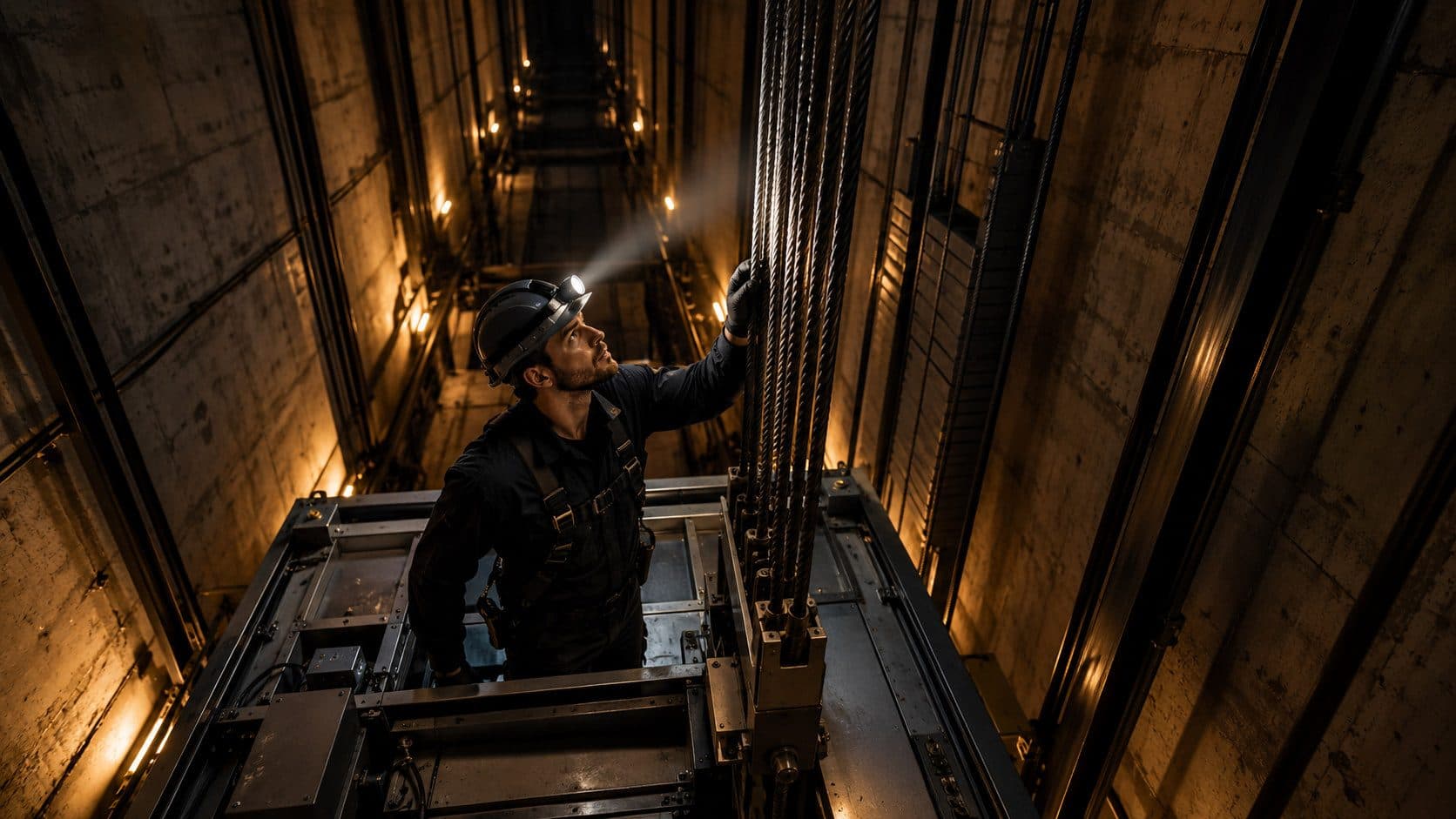
There is a real lift engineer shortage in Spain, the UK, France and the US. More lifts get installed every year, every one has to be maintained by law, and not enough young people are going into the trade. Recruit and keep your own qualified engineers and winning lift maintenance contracts is the easy part.
I saw a report about this on Spanish TV and it stayed with me all night. So let me give you the numbers, then let me show you how I would play it.
If I had to pick one trade to study today, it would be lift engineering
Listen. If I was 18 again and someone asked me which trade to learn, I would not say plumber. I would not say electrician. I would say lift engineer.
Here is why, in one line: more lifts, fewer engineers, and the law says the work has to be done.
- More lifts. Cities build up, not out. Every new block of flats, every hospital, every office goes in with lifts. And the old ones get modernised instead of ripped out.
- More maintenance. A lift is not a job you finish. It is a contract that runs for as long as the building stands. Inspections, servicing, call-outs, upgrades when the rules change.
- Fewer engineers. A big part of the trade is the older generation, and the young ones would rather sit behind a screen than climb on top of a lift car. The people who do the job know it, and they get paid for it.
That is the setup every construction arbitrage operator should be looking for. Demand nobody can skip, and labour nobody can find.
The lift engineer shortage, country by country
This is not one country with a bad year. It is the same story in every market I look at.
Spain: 1.2 million lifts and nobody to fix them
Spain is the one I saw on TV, and the numbers are wild. Spain has around 1.2 million lifts running every day, the biggest lift fleet in Europe in absolute terms. That makes sense when you know that 65.3% of Spaniards live in flats, the highest share in the EU.
According to an EFE report published in September 2026:
- The sector leaves up to 25% of its technician posts unfilled.
- José Carlos Frechilla, director of Feeda (the Spanish lift federation), says the industry needs about 1,400 new technicians every year.
- InfoJobs counted 1,000 lift engineer vacancies in 2025.
- At Fain Ascensores, which has 800 technicians across Spain, people start on about 24,000 euros and experienced profiles reach 50,000 euros, before voluntary on-call pay.
- Feeda expects the after-sales side (maintenance and repair) to grow 8-10% by the end of 2026, while new installations stay flat.
Read that last point twice. New installs are flat. Maintenance is growing. The money is in keeping lifts running, not putting them in.
Fain's head of people, Delia Carmona, blames it on too few students choosing electronics and mechatronics courses, and on aeronautics and car makers stealing the ones who do. Frechilla says young people still see the lift trade as "dark and dangerous". A trade with zero unemployment that young people refuse to get into. That is the gap.
Telemadrid ran a report saying Madrid alone needs about 300 new lift technicians a year, for close to 200,000 lifts. And since 1 July 2024, a new lift safety instruction (Real Decreto 355/2024, ITC AEM 1) brought in mandatory safety measures for existing lifts. More rules means more work per lift. Same number of engineers.
United States: the best paid trade on the building site
In the US the Bureau of Labor Statistics puts the median elevator installer and repairer at $109,910 a year (May 2025). The top 10% earn more than $158,890. Business Insider, using BLS data, called it the highest average wage of any construction and extraction job.
There are only about 24,700 of them in the whole country. BLS expects the job to grow 6% from 2025 to 2035, with about 1,900 openings a year, mostly to replace people who retire or leave.
Otis CEO Judy Marks told Business Insider in May 2026 that they cannot hire elevator mechanics fast enough. Otis has about 45,000 mechanics in the field and it is still not enough.
I will be honest with you, because I promised I always would on this site: Marks also says Otis does not have a retirement cliff, and that the real squeeze is demand. Fine. Whether it is boomers retiring or demand outrunning hiring, the result for you is the same. Not enough engineers for the lifts that need them.
United Kingdom: six-monthly checks, by law
In the UK, the HSE says equipment that lifts people must be thoroughly examined at six-monthly intervals, or under a written examination scheme. Every passenger lift in every block, hotel, school and office. Twice a year, minimum, forever.
Pay is solid. Glassdoor puts the average lift engineer in London at about £42,000, and live job adverts go to £50,000-£55,000 with paid overtime and standby. Even the apprentices are paid properly: an Otis lift and escalator apprenticeship on the government site started at £16,416 in year one and rose to £30,096 in year three.
France: the federation is asking for foreign engineers
In October 2024, France's lift federation (Fédération des Ascenseurs) asked for the job to be recognised as a shortage occupation in Île-de-France, Provence-Alpes-Côte d'Azur and Auvergne-Rhône-Alpes, and said the trade has to open up to foreign professionals. When an industry body goes public asking to bring people in from abroad, you know the shortage is real.
Why construction arbitrage works in lift maintenance
Now the part nobody else will tell you.
On most of my work, construction arbitrage means: win the job, sub it out, keep the spread. Plumbing, roofing, decorating, I have 1,500+ subcontractors for that.
Lifts are different. Here you want in-house operatives.
Three reasons:
- It is regulated. Most US states license elevator mechanics. The UK has the six-monthly examinations. Spain has its own lift rules. You cannot throw a lift job at a random sub and hope. The client, the insurer and the inspector all want a named, qualified company and a named, qualified engineer.
- The subs do not exist. There is no big pool of freelance lift engineers waiting for your call. The good ones are already employed, and they are busy.
- The contract is recurring. A lift maintenance contract is not a one-off job. It is monthly money, every month, for years. You want that locked to your company, not to a sub who can walk away with your client.
So here the arbitrage moves. You are not arbitraging the job. You are arbitraging the recruitment.
The client pays you a fixed monthly contract per lift. You pay your engineer a salary. The engineer covers a route of lifts. The spread between what a route of contracts brings in and what that engineer costs you, all in, is your margin. Every extra engineer you recruit and keep is another route, another block of monthly money.
This is step 5 of the way I built my own business: in-house operatives on a day rate, with systems so I did not have to be there. In most trades I moved past it and subbed everything. In lifts, step 5 is where you stay, because that is where the moat is.
In lifts, whoever owns the engineers owns the market. Recruit the engineers and the contracts come to you.
The numbers: how the maths works (example only)
Figures in USD, the model and the maths are identical in any currency. These are example numbers to show the shape, not market prices and not a promise. Your numbers will be different. Price your own market before you do anything.
Say you recruit one qualified engineer:
- Cost of the engineer, all in: salary, van, fuel, tools, training, insurance, on-call pay, payroll tax. Say $140,000 a year.
- What they cover: a route of maintenance contracts they can service properly, plus call-outs.
- What the route brings in: say 60 lifts at $250 a month each. That is $15,000 a month, $180,000 a year.
- On top: call-outs, repairs and modernisation quotes, which is where a lot of the real money sits.
On those example numbers, the contracts alone leave $40,000 a year before your overheads, admin, parts and your own time. Then the repairs and upgrades come on top. Now do it with five engineers. Ten.
What you actually need to check before you trust any of this:
- Your local price per contract. Ask building managers what they pay today.
- How many lifts one engineer can service properly in your area, with travel. Ask engineers, not salesmen.
- Licensing, company registration and insurance where you operate. This changes by country and by state, and it is not optional.
What gets you killed in this niche
No such thing as risk free. Here is what goes wrong:
- Losing your engineer. If one engineer holds all your contracts in their head and leaves, you are in trouble. Pay them well, give them a reason to stay, and write everything down.
- Skipping compliance. One unlicensed engineer, one skipped inspection, one accident, and you are finished. In this trade, people get hurt when corners get cut.
- Underpricing to win. The big players will undercut you on price. Do not race them to the bottom. Win on response time and on actually picking up the phone.
- Growing faster than you can hire. Never sign contracts you do not have the engineers to service. A missed call-out with someone stuck in a lift is not a bad review, it is a lost contract.
How I would start a lift maintenance company today
- Start with recruitment, not clients. Find one or two qualified engineers first. Look at people near retirement who would take a lighter route, people from the big firms who are tired of the targets, and apprentices just finishing.
- Get the paperwork right. Company registration, the licences where you work, insurance. Do it before you take one contract.
- Win the first contracts with building managers. Property managers, housing associations, hotels, private blocks. They already have lifts, they already pay someone, and a lot of them are unhappy with their response times.
- Build the systems. Route planning, inspection records, call-out process, photos and reports on every visit. Same as any arbitrage business: if it only works when you are there, it is not a business.
- Fund your own apprentices. The shortage is your moat. Train your own pipeline and your competitors cannot catch you.
If you want to see how the rest of the model works, read what construction arbitrage really is, the difference between a contractor and a subcontractor, and how a property maintenance business wins the same kind of recurring clients. And if you are thinking about the end game, ContractorExit wrote up what makes a lift maintenance company worth buying.
The room where people actually build this is the community below. Come in, ask your questions, and bring your numbers.
Last checked: 22 October 2026.
Frequently asked questions
Is there a shortage of lift engineers?+
Yes, in several countries. Spain's lift federation says the sector needs about 1,400 new technicians a year and leaves up to 25% of technician posts unfilled. France's lift federation has asked for the trade to be listed as a shortage job. In the US, the CEO of Otis has said the company cannot hire mechanics fast enough.
How much do lift engineers earn?+
In the US, the Bureau of Labor Statistics puts the median elevator installer and repairer at $109,910 a year (May 2025), with the top 10% above $158,890. In Spain, starting pay is around 24,000 euros and experienced technicians can reach 50,000 euros before on-call pay. In London, Glassdoor's average is about 42,000 pounds.
Can you subcontract lift maintenance like other construction work?+
Not easily. Lift work is regulated almost everywhere: most US states license elevator mechanics, the UK requires lifts that carry people to be thoroughly examined every six months, and Spain has its own lift safety rules. That is why this niche rewards in-house, qualified engineers instead of a loose bench of subs.
Why is lift maintenance a good business?+
Every lift has to be maintained and inspected for as long as it runs, so the work is recurring and the client cannot skip it. Lifts keep getting installed, safety rules keep getting tighter, and qualified engineers are scarce. Recurring demand plus scarce labour is where margin lives.
Is lift engineering a good trade to learn?+
On the numbers, yes. It is one of the best paid construction trades in the US, unemployment in it is close to zero in Spain, and the work cannot be offshored. It takes years to qualify, usually through a four-year apprenticeship in the US, which is exactly why the people who get there are paid well.

Mohamed El HadriCo-Founder
I'm a co-founder of several construction companies. I built a construction business from a 30-van operation into a lean model with 1,500+ subcontractors in the database - winning the work as the main contractor, subbing it out, and running it as a system from a laptop across multiple countries. I write this site from what actually works.
@mointhemarket · 30k followers on Instagram →Run the model with people who already do
Reading the method is step one. Inside Construction Arbitrage Players you connect with players from around the world who run construction arbitrage every day and make real money from it - share your deals, get answers, and get in the game. Founding-member access is open now.
For the operator life and the inside story, see Contractor Club.
THE EDGE - the listening book on how the money really moves through a contracting business - is out now. Listen free, or see what is inside.
The Family Secret - how construction arbitrage really works - is coming soon.
A construction business built this way is a sellable asset
Systems, subs and margin - that is exactly what buyers pay for. If you own a construction or trade business and the exit is on your mind, list it on ContractorExit, the marketplace for buying and selling trade businesses. The valuation is free, so you find out what it is worth before you decide anything.
Get the Construction Arbitrage playbook
One sharp email a week: real numbers, live deal breakdowns, and the systems that let you run jobs you never visit. No fluff, unsubscribe anytime.