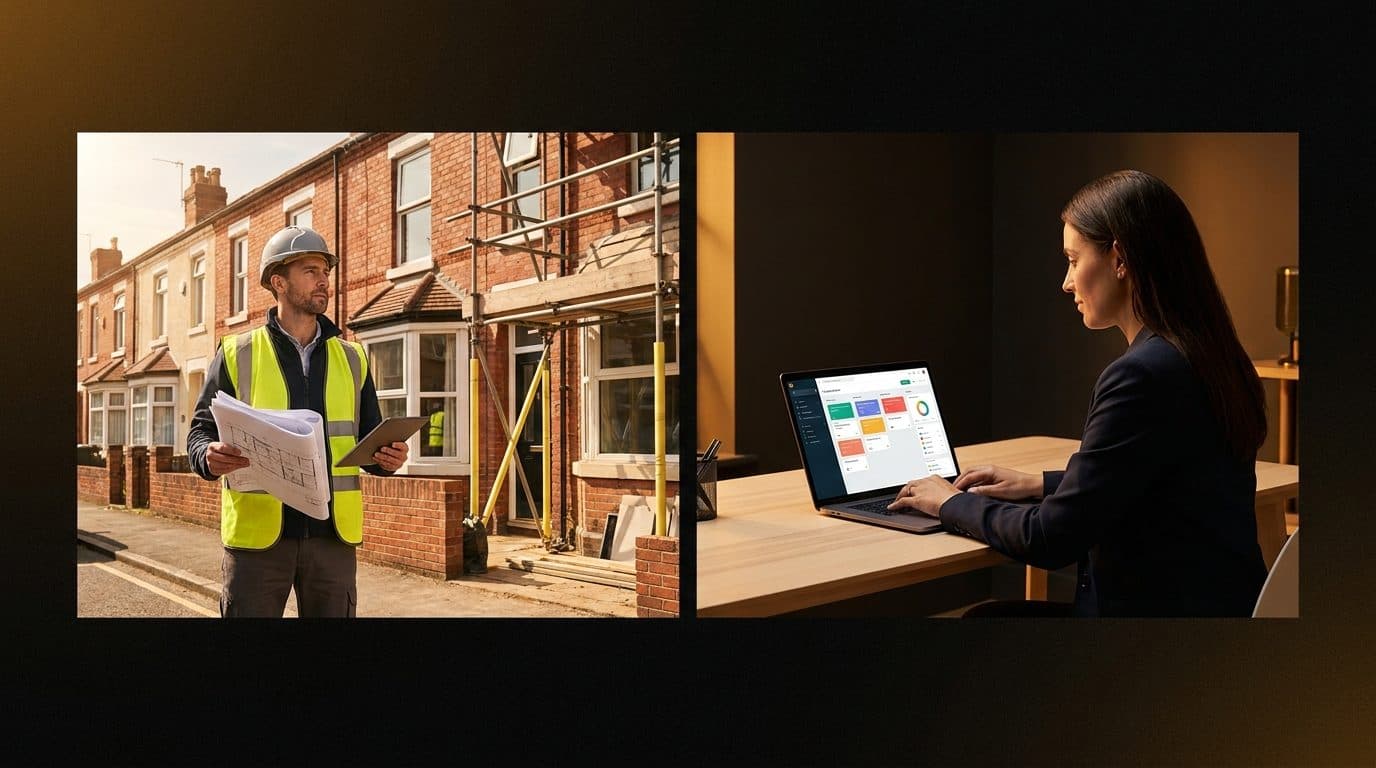
Let's deal with the question honestly, because the answer is more useful than a flat yes or no.
The model is completely legitimate. The marketing around it often isn't.
The model is as old as building itself
Every main contractor on a major project subcontracts the trades and keeps a margin. Every property developer hires builders and sells at a profit. Every facilities-management company you've heard of dispatches subcontractors and bills the client more than they pay. This is not a loophole someone discovered on YouTube in 2021 - it is the default structure of the entire construction industry.
"Construction arbitrage" is just a sharper, more deliberate name for running that structure as a lean, remote-first business instead of inheriting it after twenty years on the tools.
So when someone asks "is it legit?", the model passes instantly. It's how skyscrapers get built.
So why does it get called a scam?
Because a wave of course-sellers wrapped a real business in fantasy marketing:
- "Make $20k/month with no experience and no risk."
- "Fully passive - the trades do everything."
- "No skills needed, just follow my system."
Those claims are the scam, not the model. Here is the honest version of each:
- It is not passive. You are the point of accountability. When a sub no-shows at 7am, that's your phone ringing. The systems reduce the work; they don't delete it.
- It is not risk-free. You sign the client contract. If the job goes wrong and you've spent the deposit, you're liable for putting it right. Real money is on the line.
- It does need skill. Not trade skill - business skill. Sales, pricing, judgement of people, organisation under pressure. If you have none of those, this is hard.
Strip the fantasy and you're left with a genuinely good business. Keep the fantasy and you'll quit at the first hard job.
The genuine risks (read these before you start)
- You misjudge a job and your margin evaporates. You quoted $8k, the job had hidden problems, the trade's bill comes in at $7k, you make $200 for a month of stress. Mitigation: scope properly, price contingency, never quote blind. See Quoting & Estimating Remotely.
- A subcontractor lets you down. No-shows, poor work, walking off mid-job. This is the single biggest operational risk. Mitigation: vet hard, hold back payment until milestones are met, build a bench of more than one trade per discipline. See How to Find & Vet Subcontractors.
- Cash flow kills you. You pay the trade before the client pays you. Mitigation: structure deposits and staged payments so you are never out of pocket. See Cash Flow: Getting Paid Before You Pay.
- You cut a legal corner. Uninsured work, unqualified trades on regulated work, no written contract. This is where "scam" becomes real - for the client. Don't be that operator. See Contracts, Insurance & Staying Legal.
None of these are reasons not to do it. They're the reasons the margin exists. Manage them well and they become your moat.
What the industry's own vetting machinery says
Here's a piece of evidence you won't find anywhere else, because it comes from our own research. We track 557 UK routes to construction work - council approved lists, housing association supplier portals, framework registrations, insurer and facilities-management networks - and we've catalogued exactly what each one asks a contractor to prove at sign-up.
More than 200 of the 557 demand insurance evidence at registration. Well over a hundred ask for references or filed accounts. And the number that ask whether you will do the work with your own hands? Zero. Exactly one route in the entire dataset even asks about directly employed staff.
Think about what that means. The organisations with the most at stake - councils, housing associations, insurers - have built their entire vetting machinery around the assumption that the company winning the work may not be the people swinging the hammer. They vet the company: its insurance, its finances, its track record. Subcontracted delivery isn't a loophole they missed; it's the delivery model their paperwork is designed for. If the model were illegitimate, the most risk-averse buyers in the country would not have standardised around it. I've written up the full picture in the UK's subcontracting rules and whether construction arbitrage is legal.
The ethics of the margin
This is the part people wrestle with, so let's settle it.
You are not "ripping off" anyone when:
- The client gets a finished job, on time, with one company standing behind it and a number to call if anything's wrong - which is exactly what they're paying for, and more than a random one-man band off a directory gives them.
- The subcontractor gets paid a fair, agreed day rate for work delivered to their door without them spending a penny on marketing or a minute chasing payment.
Everyone in the chain gets something they wanted at a price they agreed to. That's not exploitation - that's a functioning market. You earn the margin by absorbing the two things neither of the others wanted: finding the work and owning the risk.
The day you stop adding value - stop answering, stop guaranteeing, stop managing - is the day the margin becomes unfair. Keep earning it and it's yours with a clear conscience.
How to tell a legitimate operator from a cowboy
Whether you're a client sizing up a contractor or an operator wanting to build this properly, the test is the same. A legitimate operation has:
- A written contract in the company's name. The client contracts with the business, the business owns the outcome. A cowboy works off a text message and vanishes when it goes wrong.
- Insurance that matches the work. Public liability at a level the contract actually requires, and qualified trades on regulated work - Gas Safe on gas, certified electricians on notifiable electrical work. No exceptions, ever.
- Vetted, insured subcontractors. Not the cheapest person who answered a group post that morning. Vetting is the operator's real job - it's most of what the risk management looks like in practice.
- Staged payments, not everything upfront. A deposit that covers materials is normal. Demanding the full job price before work starts is the single loudest warning sign in the industry.
- A person who answers the phone after the invoice is paid. Accountability is the product. If it disappears at practical completion, the margin was never earned.
Notice that none of these tests ask "do you subcontract?" - they ask "do you stand behind the job?". That's the line between arbitrage and dishonesty, and it's the same line every serious buyer in the industry draws.
The honest bottom line
Construction arbitrage is a real, durable, ethical business that has built the cities you live in. It is not passive, not risk-free, and not skill-free. If a course told you otherwise, distrust the course, not the model.
If that honest version still appeals to you - and for the right person it should - start with How Construction Arbitrage Works and then the 90-Day Start Plan.
Frequently asked questions
Is construction arbitrage a scam?+
The model itself is not a scam - it is how general contractors, main contractors and developers have always worked. What gets called a scam is the marketing around it: courses promising passive five-figure months with no skill or risk. The model is legitimate; the get-rich-quick framing is not.
Is it ethical to charge more than the subcontractor?+
Yes, provided you are genuinely doing the work of finding clients, carrying risk, guaranteeing the result and managing delivery. You are not skimming a passive cut - you are providing accountability and co-ordination the client values and the trade does not want to provide. If you add no value and hide it, that is not arbitrage, it is just dishonesty.
Do I have to tell the client I use subcontractors?+
You do not need to expose your margin, just as no business reveals its cost price. But you must never misrepresent who is doing the work or their qualifications, and your contract should make clear the client is contracting with your company, which may use vetted subcontractors. Transparency about responsibility, discretion about pricing.
How can I tell if a construction arbitrage course is legit?+
Look at what it spends its time on. A legitimate teacher spends most of the material on the boring parts - contracts, insurance, pricing, vetting trades, cash flow - because that is where the business is won or lost. Red flags: guaranteed income claims, 'no risk' or 'fully passive' promises, countdown timers, and zero mention of what happens when a job goes wrong. The model is real; a course that hides its hard parts is selling the fantasy, not the business.
Mohamed El HadriCo-Founder
I'm a co-founder of several construction companies. I built a construction business from a 30-van operation into a lean model with 1,500+ subcontractors in the database - winning the work as the main contractor, subbing it out, and running it as a system from a laptop across multiple countries. I write this site from what actually works.
@mointhemarket · 30k followers on Instagram →Run the model with people who already do
Reading the method is step one. Inside Construction Arbitrage Players you connect with players from around the world who run construction arbitrage every day and make real money from it - share your deals, get answers, and get in the game. Founding-member access is open now.
For the operator life and the inside story, see Contractor Club.
THE EDGE - the listening book on how the money really moves through a contracting business - is out now. Listen free, or see what is inside.
The Family Secret - how construction arbitrage really works - is coming soon.
A construction business built this way is a sellable asset
Systems, subs and margin - that is exactly what buyers pay for. If you own a construction or trade business and the exit is on your mind, list it on ContractorExit, the marketplace for buying and selling trade businesses. The valuation is free, so you find out what it is worth before you decide anything.
Get the Construction Arbitrage playbook
One sharp email a week: real numbers, live deal breakdowns, and the systems that let you run jobs you never visit. No fluff, unsubscribe anytime.