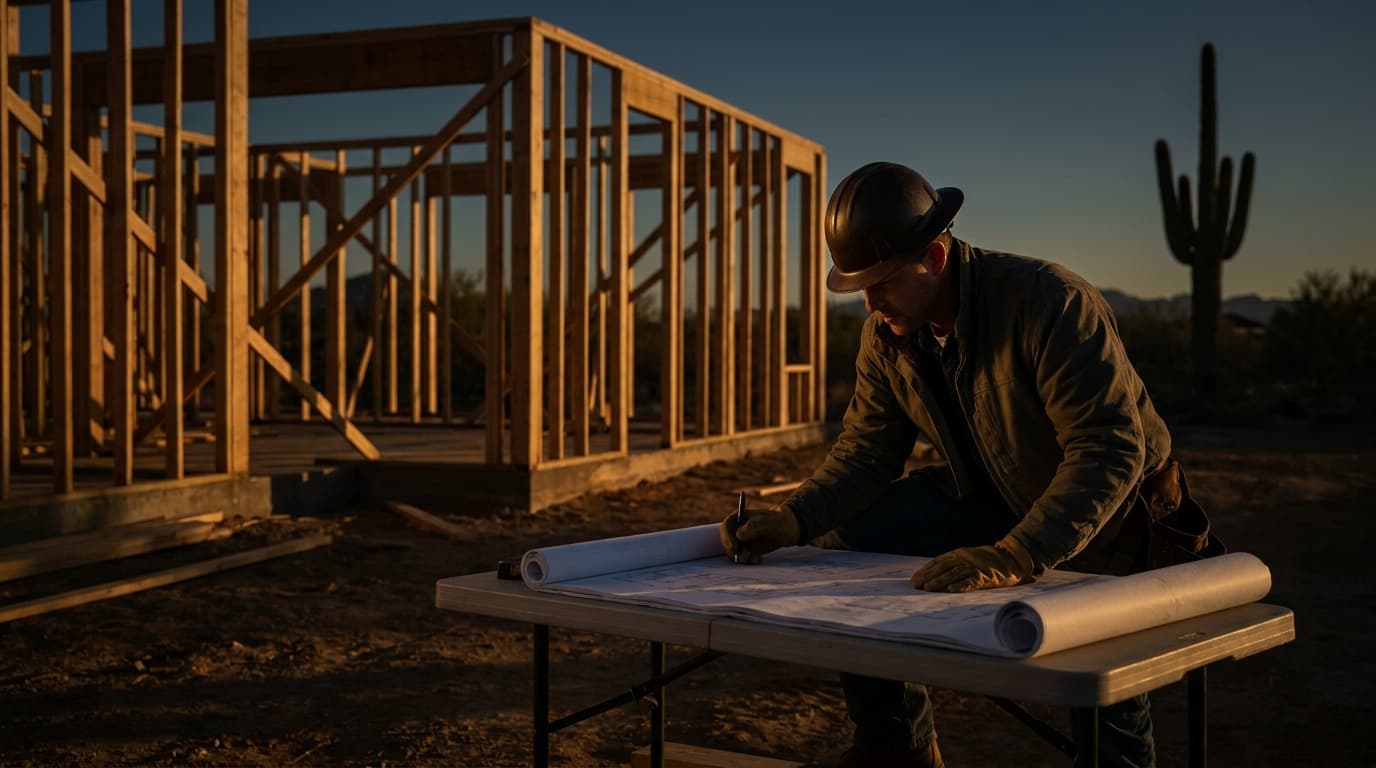
A contractor signs the prime contract directly with the client and owns the project. A subcontractor signs with the contractor, not the client. The contractor vs subcontractor distinction is not about skill or trade - it is whose name is on the contract, who carries the liability when something goes wrong, and where the money flows first. That one difference changes everything about who owns the risk.
The contractor vs subcontractor divide: who signs what
In any construction project the chain works like this:
Client - Main contractor - Subcontractors
The client signs one contract with the main contractor (also called the general contractor, or GC). The main contractor then signs separate contracts with each subcontractor they bring in - electricians, plumbers, groundworkers, tilers. The client has no direct contract with any of those subcontractors. They never signed anything with the sparky. They hired you.
Titles multiply from here, but they all point at the same two positions. "Prime contractor" is the term you will see most on government and larger commercial jobs - it means exactly the same thing as main contractor or GC: the party holding the direct contract with the owner. On the trade side, subcontractors get called "trade contractors" or "specialty contractors" just as often - electrical, plumbing, drywall, roofing, each one a trade contractor working a defined package under the main contractor. Different label, same position in the chain. Most GCs subcontract almost all of the physical work anyway - the main contractor title describes who holds the contract, not who swings the hammer.
This matters because of the legal doctrine of privity of contract: you can only enforce a contract against someone who is party to it. The client's legal relationship is with the main contractor. Full stop. If the plumber floods the bathroom, the client calls the main contractor. The main contractor calls the plumber.
I went through this shift myself when I moved from doing the work to running the jobs. The moment my name was the one on the contract with the homeowner, everything changed. Every complaint, every defect call, every "this is not what I asked for" came to me. I dealt with it, then dealt with the sub. That accountability is the line between the two roles.
The difference between contractor and subcontractor at a glance
Every difference between the two roles falls out of that one fact - whose name is on which contract. Here is the whole comparison in one table:
| Main contractor | Subcontractor | |
|---|---|---|
| Contract is with | The client | The main contractor |
| Scope | The whole project | A defined trade package |
| Liable to | The client, for all work on the job | The main contractor, for their own scope |
| Paid by | The client, on milestones or completion | The main contractor, usually net 30-60 after invoicing |
| Client relationship | Owns it | Usually none |
| Earns | The margin on the whole job | Their rate for the scope delivered |
| UK tax (CIS) | Deducts tax from subs' labour payments | Has 20%, 30% or 0% deducted at source |
Read the rows together and the pattern is obvious: the main contractor trades more risk and more waiting for control of the client and the margin on the whole job. The subcontractor trades the margin for a simpler position - deliver the scope, invoice, move on.
Who carries it when things go wrong
The main contractor carries the primary liability to the client for every piece of work on the project - including work done by their subcontractors. In the US, federal regulations place overall responsibility squarely with the prime contractor. UK construction law takes the same position. You hired the sub. You vouched for them. If they do poor work, it is your problem to fix before it becomes the client's.
Subcontractors carry liability too - but to the main contractor, not to the client. A subcontractor who does defective work can be pursued by the GC for remediation costs or damages. Most well-drafted subcontract agreements include indemnification clauses that require the sub to hold the GC harmless for claims arising from the sub's own work. In the UK there is a layer of law on top of the contract - CDM 2015 duties, CIS deductions, insurance and payment flow-down - and I've broken down the full set in the UK subcontracting rules guide.
This is why the quality of your trade bench is your reputation. If you are running the construction arbitrage model - winning the work and subbing out the execution - a client who is delighted does not care that you were not on the tools. A client who is unhappy does not care who caused it. The contract runs through you.
Can a subcontractor hire their own subcontractor?
Yes - this is called a second-tier or lower-tier subcontractor, and it is common on specialist packages where a sub brings in another specialist to cover part of their own scope. The chain just gets one link longer: client to main contractor to first-tier sub to second-tier sub. Privity of contract still runs the same direction - the second-tier sub's contract is with the first-tier sub, not with you or the client, so their comeback on non-payment or a dispute stops at whoever hired them.
Most standard-form subcontracts do not leave this open by default. The AIA A401 form, widely used in the US, requires the sub to get the main contractor's written consent before subcontracting any of their own work, and the original sub stays fully responsible for the second-tier sub's performance through a flow-down clause - whatever obligations you owe the client flow down through every tier below you. Build the same consent requirement into your own subcontract agreements; see contracts, insurance and staying legal for what else belongs in that document. Skip the clause and you can end up with an unvetted sub on your site that you never approved and have no direct comeback against.
Where the money flows - and who waits longest
Money flows down the chain: client pays the main contractor, main contractor pays the subcontractors. The problem is timing. Main contractors are typically paid on milestones or at completion. Subcontractors often wait net 30, 45, or 60 days after invoicing - sometimes longer.
Late payment is chronic in construction. In the UK, the average delay beyond agreed terms ran to over 38 days in recent years, with construction consistently ranked as one of the worst-affected sectors. Subcontractors feel this most acutely because they carry material and labour costs in the meantime.
The main contractor earns the spread - the difference between what the client pays and what the subs charge. On residential renovation work in the US, gross margins of 20-35% on top of sub costs are typical for small jobs. That margin is not free money. It covers overhead, insurance, risk, and the coordination work the GC performs. See how much general contractors mark up subcontractors for a full breakdown of where that spread lands once costs are stacked against it.
Subcontractor vs independent contractor vs in-house: sorting the labels
Three terms get tangled here, and they answer different questions. "Subcontractor" is a commercial position: contracted to the main contractor, not the client. "Independent contractor" is an employment-status label - self-employed rather than an employee, the 1099 worker in US terms, the self-employed CIS subbie in UK terms. Most subs are independent contractors for tax, but an independent contractor working directly for a homeowner is not subcontracting anything - on that job they are the contractor.
"In-house" (or directly employed) trades are the third category: on the payroll, PAYE or W-2, covered by the employer's insurance, no separate contract per job. Large firms run a mix; almost every small main contractor I know runs subs instead, because employed trades cost you in the quiet weeks and subs cost you only when there is work. The trade-off is control - an employee works to your schedule, a sub works to their contract.
Where the contractor-subcontractor relationship actually breaks down
Ask anyone who has run both sides and the friction shows up in the same handful of places, run after run:
- Payment timing. Covered above, but it is the single biggest source of tension. A sub who is owed money for 60 days is not a sub who prioritises your next job.
- Scope creep. The client asks for "one more thing" on site, you say yes to keep them happy, and the sub is now doing extra work against their original quote. Get change orders in writing before the sub touches anything outside scope, every time.
- The communication chain. Clients want to talk to the person doing the work, not you. Subs want to talk to you, not chase the client for decisions. You are the translator in both directions, and skipping that role is how instructions get lost and blame gets murky.
- Quality control at the handover point. Who checks a trade's work before the next trade covers it up - plastered over, tiled over, boxed in? If you are not inspecting each package before the next one starts on top of it, defects get expensive and hard to trace back to the right sub.
- Insurance and certificate chasing. A sub whose public liability lapsed mid-job is a problem you find out about at the worst possible time. Vet subcontractors properly before you hire them and you cut most of this off before it starts.
None of this is unique to construction arbitrage - it is the normal cost of running a trade chain instead of doing every trade yourself. The GCs who run it well are not the ones with the fewest problems. They are the ones with a system for catching each problem early, before it reaches the client.
How this maps onto construction arbitrage
If you want to understand what construction arbitrage is, the contractor vs subcontractor distinction is the foundation. Construction arbitrage is the business model where you operate as the main contractor - your name on the client contract - and subcontract the physical execution. You earn the spread. You carry the accountability. You run it as a system instead of being on the tools.
The subcontractor position is different. A subcontractor earns their rate for the scope they execute. They do not manage the client relationship, they do not carry the full project liability, and their income is capped by the hours they or their team can physically work. The construction arbitrage vs subcontracting breakdown goes deeper on how those two positions differ in practice and which one builds a scalable business.
The thing I tell anyone new to this model: you are not hiding behind the sub or passing the work off. You are the named contractor. The client chose you. That accountability is real - and it is exactly what justifies the margin.
Three questions that follow naturally from this one:
Do you have to tell the client you are subcontracting the work? In most cases, no - unless the contract requires it. What you are always obligated to deliver is the result the client paid for.
Can a general contractor subcontract all the work? On private jobs, yes. There is no law requiring you to self-perform any minimum share. You hold the contract; you choose how to execute it.
How do you go from subcontractor to main contractor? The paperwork rung takes weeks. The rung that takes time is track record, and the two places firms fall off are retentions and coordination risk.
The full breakdown of how to structure the sub agreements, the client contract, and the margin stack is in THE FAMILY SECRET - How Construction Arbitrage Really Works (coming soon).
Frequently asked questions
Is a general contractor the same as a contractor?+
Yes, in construction the terms are used interchangeably. A general contractor (or main contractor in the UK) is the business that holds the prime contract with the client and manages all the trades on a project. Specialist contractors or subcontractors work under them on separate contracts.
Can a subcontractor work directly for a client?+
A subcontractor can approach a client directly and win work in their own right - at that point they become the main contractor for that job. The distinction is not about the business, it is about the contract on any given project. On one job you might sub to a GC; on your own jobs you are the main contractor.
Who is responsible if a subcontractor does bad work?+
The main contractor is responsible to the client. The client's contract is with the GC, not with the sub, so any defect claim comes to the main contractor first. The GC then pursues the sub directly. This is why the main contractor carries more risk - and why they earn the spread on top.
Does a subcontractor need their own insurance?+
Yes. Any subcontractor you hire should carry their own public liability and employer's liability (or workers' compensation in the US). This does not remove your liability to the client, but it gives you recourse if the sub's work causes a claim. Never hire an uninsured sub.
What is the difference between a contractor and subcontractor for tax purposes?+
In the UK, the Construction Industry Scheme (CIS) applies: main contractors deduct tax at source from subcontractor payments and pass it to HMRC. In the US, subcontractors are typically treated as independent contractors and receive a 1099 - they handle their own self-employment tax. Either way, the main contractor has reporting obligations.
Can the client sue a subcontractor directly?+
In most cases, no. The doctrine of privity of contract means you can only enforce a contract against someone who is a party to it. The client signed with the main contractor, not the subs. Some jurisdictions allow exceptions - mechanics lien rights, for instance, give subs a route to payment protection - but direct client claims against subs are the exception, not the rule.
What is the difference between a subcontractor and an independent contractor?+
They answer different questions. Independent contractor is an employment-status label - self-employed rather than an employee, a 1099 worker in US terms. Subcontractor describes a commercial position in the project chain: contracted to the main contractor rather than the client. Most subcontractors are independent contractors for tax purposes, but an independent contractor working directly for a client is not a subcontractor - on that job they are the contractor.
What is the difference between a general contractor and a subcontractor?+
A general contractor holds the direct contract with the client and manages the whole project; a subcontractor is hired by the general contractor, or by another subcontractor, to deliver one trade package such as electrical or plumbing. The general contractor - also called the main contractor or prime contractor - carries the liability to the client for the finished job. The subcontractor is liable only to whoever hired them.
Can a subcontractor hire their own subcontractor?+
Yes. This is called second-tier or lower-tier subcontracting and it is common on specialist packages. Most standard subcontract agreements require the main contractor's written consent before a sub can bring in their own sub, and the original sub stays responsible for the second-tier sub's work under the subcontract's flow-down clause.

Mohamed El HadriCo-Founder
I'm a co-founder of several construction companies. I built a construction business from a 30-van operation into a lean model with 1,500+ subcontractors in the database - winning the work as the main contractor, subbing it out, and running it as a system from a laptop across multiple countries. I write this site from what actually works.
@mointhemarket · 30k followers on Instagram →Run the model with people who already do
Reading the method is step one. Inside Construction Arbitrage Players you connect with players from around the world who run construction arbitrage every day and make real money from it - share your deals, get answers, and get in the game. Founding-member access is open now.
For the operator life and the inside story, see Contractor Club.
THE EDGE - the listening book on how the money really moves through a contracting business - is out now. Listen free, or see what is inside.
The Family Secret - how construction arbitrage really works - is coming soon.
A construction business built this way is a sellable asset
Systems, subs and margin - that is exactly what buyers pay for. If you own a construction or trade business and the exit is on your mind, list it on ContractorExit, the marketplace for buying and selling trade businesses. The valuation is free, so you find out what it is worth before you decide anything.
Get the Construction Arbitrage playbook
One sharp email a week: real numbers, live deal breakdowns, and the systems that let you run jobs you never visit. No fluff, unsubscribe anytime.