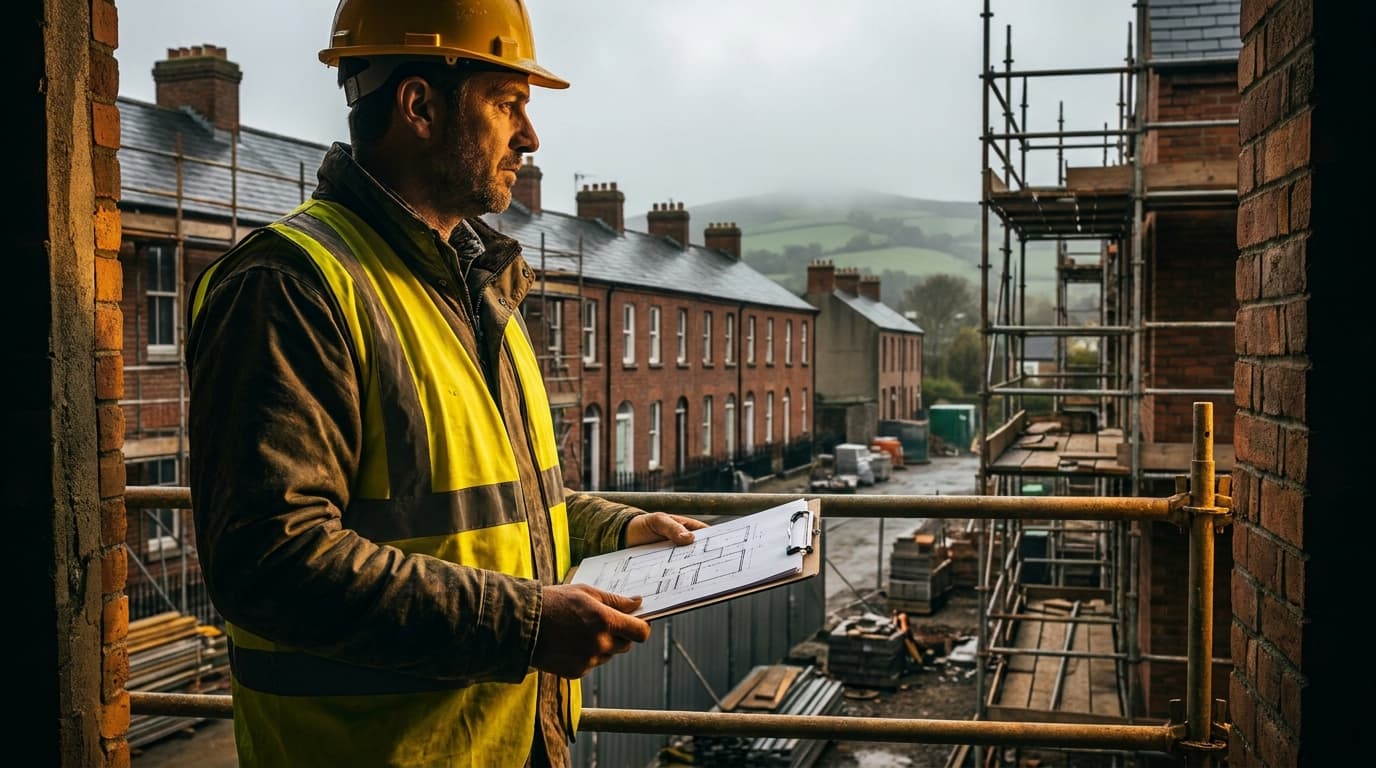
Most general contractors do very little physical work themselves. The typical residential builder subcontracts around 84% of construction costs and uses 24 different trade contractors to build a single home, according to NAHB research. The GC's job is coordination, client management, and commercial control - not lifting, fixing, or finishing. The trades do the physical work; the contractor manages the project.
This is the part that surprises people when they first encounter construction arbitrage: the idea of winning a construction job and subbing out the labour is not a workaround. It is how the industry has always worked. Most GCs who have been running for five years or more spend the majority of their time on the phone, on site visits, and in the office - not with tools in hand.
What general contractors actually do
The GC's function is management, not construction. On any given job, the contractor is responsible for:
- Winning the work and negotiating the prime contract
- Pricing the project and protecting the margin
- Selecting, vetting, and scheduling the right tradespeople
- Coordinating deliveries so materials arrive when the trade needs them
- Keeping the client updated and handling complaints before they escalate
- Quality checking at key stages - not doing the work, but inspecting it
- Managing invoicing, payments to subs, and cash flow across the project
None of that involves a hammer. It is a business management role. The plumber, electrician, tiler, plasterer, roofer - each one is a specialist brought in because they are faster and better at that specific trade than a generalist GC could ever be. The GC's edge is coordination and commercial management.
The numbers: how much do GCs actually subcontract?
The National Association of Home Builders (NAHB) surveyed US residential builders and found that the average new home uses 24 different subcontractors. Builders subcontract out around 84% of construction costs in the typical home they build.
Over 90% of builders reported that they always subcontract: concrete flatwork, masonry, drywall, foundations, plumbing, electrical wiring, HVAC, carpeting and security systems. These are not edge cases - they are the core of what gets built.
Even among larger commercial operators, fewer than half of general and prime contractors self-perform more than 20% of their construction work, according to data from the Construction Financial Management Association (CFMA). The majority do less than 20% themselves. On large commercial projects - office blocks, retail fits, industrial builds - the GC is almost always a project management operation supported by a stack of specialist subs.
Where some GCs do pick up tools
There are two situations where a GC might do some physical work themselves.
Small operations, early on. A sole trader who is also a tradesman - say a carpenter who grew into running jobs - will often still do some work with their own hands on smaller projects. They might frame, fit, or finish while managing the sub-stack around them. This is common at the very small end of the market. As the volume grows, the founder typically steps off the tools because the business needs their time more than it needs their labour.
Site supervision overlap. On smaller domestic jobs, the GC or their site manager might do small items directly - a bit of clearing, minor repairs, punch list snags - because it is faster than calling a sub for a 15-minute task. This is pragmatic, not structural. It is not a trade role; it is a site manager filling a gap.
The pattern is consistent: the smaller the operation and the earlier in its history, the more likely the owner is to be doing some physical work. The larger and more systemised the business, the less they touch it.
Why this matters if you are considering the model
I started out doing work with my own hands. The first jobs, I was there. Changed washers, fixed leaks, handled the bits I could while I found the trades for the rest. Then I started using a plumber because the plumber was faster - not because I could not do it, but because an hour on the phone finding the next job was worth more than an hour under a sink.
The trade was something I chose to put down, not something I never had. That distinction matters: the skill of knowing what good work looks like does not require doing the work every day. You learn it by watching, checking, and questioning - and by working with trades long enough to know when something is not right.
The real progression is: solo work, then one or two day-rate people, then subcontractors for specific trades, then a full sub-stack and yourself out of the physical work entirely. Every step answers the question "how do I stop having to be there?" and every answer creates the next problem to solve.
By the time I had 1,500+ subcontractors in the database, I was running jobs across multiple locations without being on site for any of them. Not because GCs do not do the work - some do - but because the business model rewards management over manual labour, and systematising that is exactly what construction arbitrage is.
The construction arbitrage model is the formalised version of this
Most general contractors already operate a version of construction arbitrage without calling it that. They win prime contracts. They build a trade sub-stack. They keep the spread between the client price and the sub cost. They manage delivery from a commercial and coordination layer, not from the tools.
Construction arbitrage is just the name for building that model deliberately - as a system, from the start - rather than growing into it after years of solo work. You set up the sub database, the quoting process, the client pipeline, and the delivery management before you take your first job, not after your tenth.
The question "do general contractors actually do any of the work themselves?" has a clean answer: most do not, and the ones who do are either small, early, or choosing to for specific reasons. The model has always rewarded coordination over labour. The trades are always better at the physical work than a generalist could be. The margin is in managing the project, not picking up a tool.
If you want to understand the full model - how the spread works, what the compliance requirements are, and how to build it from scratch - start with how construction arbitrage works and the detail on what you need to start.
For the question of whether you even need a contractor licence if you are subbing everything out, the answer is covered in full in do you need a contractor licence for construction arbitrage.
The GC model has always been about managing projects, not building them. Most contractors figured that out years in. Construction arbitrage is just starting with that conclusion already reached.
The next step
If you are building this model from scratch, the room where real operators are doing it is Construction Arbitrage Players on Skool - join at skool.com/construction-arbitrage/about.
The full system - how to set up the sub database, price the spread, and run jobs without being on site - is documented in THE FAMILY SECRET - How Construction Arbitrage Really Works, coming soon.
Frequently asked questions
Do general contractors do any physical work themselves?+
Some do, most do not. The typical residential builder subcontracts around 84% of construction costs and uses 24 different trade contractors, according to NAHB data. The GC's actual job is coordination, client management, scheduling, and commercial control - not trade work. Some small GCs will pick up a tool when needed, but the physical construction is almost always done by specialists.
Is it normal for a general contractor to subcontract all the work?+
Yes. Over 90% of residential builders always subcontract trades like plumbing, electrical, HVAC, drywall, and foundations. There is no law on private work requiring a GC to self-perform any minimum percentage. The GC role is to manage the project, not to do the physical build.
What does a general contractor actually do on a job?+
A GC manages: client relationships and contract, subcontractor selection and scheduling, materials procurement and delivery, quality and safety oversight, invoicing and cash flow, and problem-solving when things go wrong on site. That is a full-time management role. The physical construction is the subcontractors' job.
What is construction arbitrage and how does it relate to GCs not doing the work?+
Construction arbitrage is the deliberate, systemised version of the GC model - you win the prime contract, subcontract the physical work to specialists, and keep the spread between what the client pays and what the trades cost. It is what most large and mid-sized GCs already do, built into an explicit business model from the start.
Can I start a construction business without doing any physical work?+
Yes. The GC model - and specifically construction arbitrage - is built on exactly this. You act as the main contractor, manage the delivery through a trade sub-stack, and make your income on the spread. You need to be licensed where required, insured, and able to manage a project - but the tools stay with the tradespeople.
Mohamed El HadriCo-Founder
I'm a co-founder of several construction companies. I built a construction business from a 30-van operation into a lean model with 1,500+ subcontractors in the database - winning the work as the main contractor, subbing it out, and running it as a system from a laptop across multiple countries. I write this site from what actually works.
@mointhemarket · 30k followers on Instagram →Run the model with people who already do
Reading the method is step one. Inside Construction Arbitrage Players you connect with players from around the world who run construction arbitrage every day and make real money from it - share your deals, get answers, and get in the game. Founding-member access is open now.
For the operator life and the inside story, see Contractor Club.
THE EDGE - the listening book on how the money really moves through a contracting business - is out now. Listen free, or see what is inside.
The Family Secret - how construction arbitrage really works - is coming soon.
A construction business built this way is a sellable asset
Systems, subs and margin - that is exactly what buyers pay for. If you own a construction or trade business and the exit is on your mind, list it on ContractorExit, the marketplace for buying and selling trade businesses. The valuation is free, so you find out what it is worth before you decide anything.
Get the Construction Arbitrage playbook
One sharp email a week: real numbers, live deal breakdowns, and the systems that let you run jobs you never visit. No fluff, unsubscribe anytime.