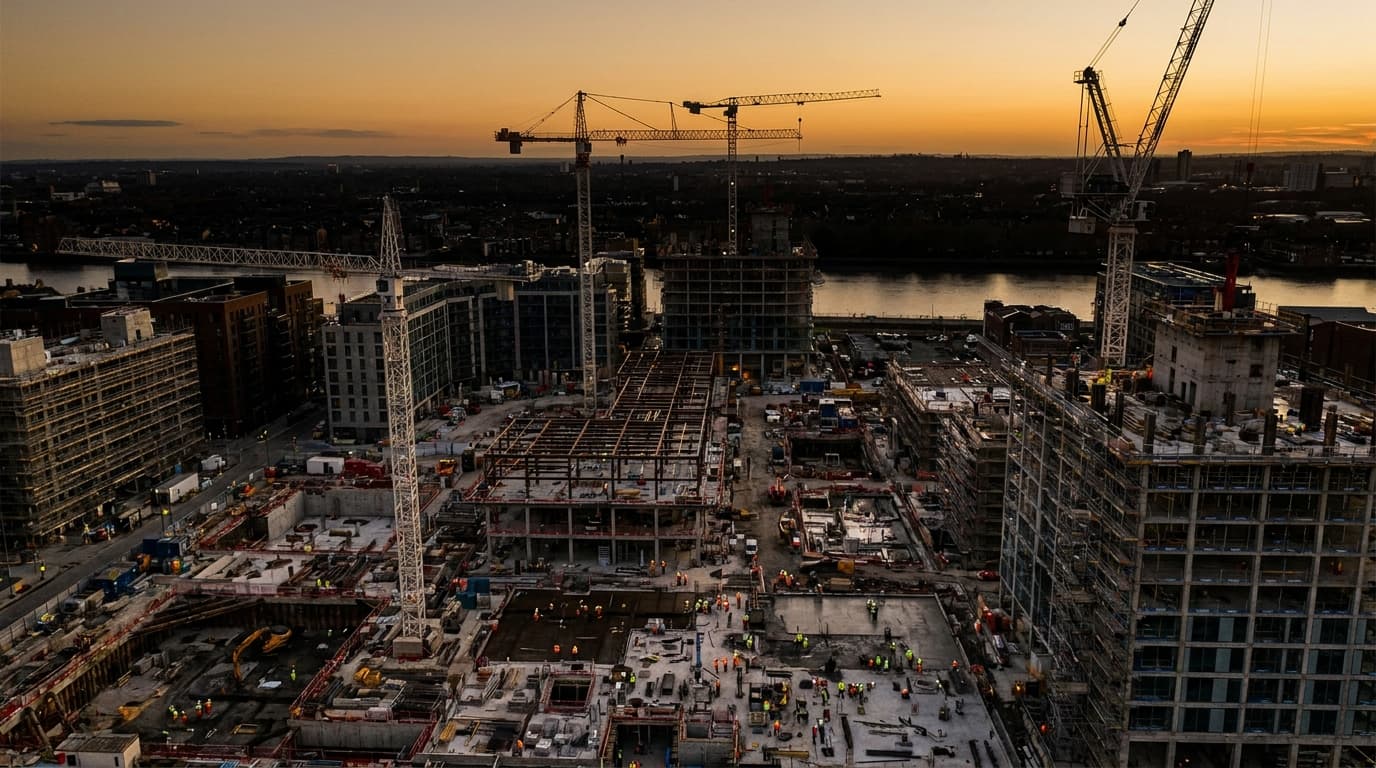
Construction arbitrage is not saturated. The US construction industry puts $2.2 trillion a year through 3.7 million businesses with no firm above 5% market share - and every job is won locally, not globally. In every market I have run this model, there is more work than there are operators organised enough to take it.
Is construction arbitrage saturated - what the numbers show
The US Census Bureau's construction spending data for May 2026 puts total annual construction activity at a seasonally adjusted rate of $2.21 trillion. That figure spans residential, commercial, infrastructure and industrial work - and it is spread across one of the most fragmented industries in any economy. IBISWorld reports that the construction industry has no company with a market share above 5%. Statista data from 2023 counts roughly 3.7 million construction businesses in the US alone, with around 814,000 of those employing staff.
That is not a market that has run out of room. That is a market so fragmented, so local, and so dependent on relationships and execution that the concept of global saturation does not apply to it.
For comparison: digital services can be saturated. An agency in London competes directly with one in Manila for the same client. A construction job in Denver is not being bid on by a main contractor in Singapore. Geography caps the competition pool on every single job.
The awareness gap is the real story
Here is the thing that surprises most people when they start looking at this seriously: the vast majority of the 3.7 million construction businesses in the US have never heard the term "construction arbitrage." They do not know they are running it. They have just always worked that way - won a job, sub'd it out, kept the difference.
The number of people who have deliberately built this as a lean, remote-first business structure with a proper sub database and system behind it is tiny relative to the market. I have run this model across multiple countries. In none of those markets have I ever lost a job because the market was too full of lean operators. I have lost jobs to price, to relationships, to timing. Never to a crowd of competitors running the same structured model.
This is an awareness problem, not a saturation problem. Most people who could run this have no idea it exists as a named, codified model. If you are reading this page, you already know more about the structure than 99% of the market you are about to enter.
Why construction is structurally resistant to saturation
Three things make this market different from most service businesses:
Geography locks competition to a local pool. A client in Austin needs a main contractor who can actually turn up to meetings, co-ordinate subs who can access the site, and take responsibility for the physical output. The competitor pool for every job is bounded by a radius. That radius might be 30 miles. It is never the whole internet.
The labour shortage is structural and growing. The construction industry needed an estimated 439,000 additional workers in 2025, rising to roughly 499,000 in 2026, according to Associated Builders and Contractors data. The Home Builders Institute's Construction Labor Market Report (Fall 2025) puts the picture in sharper relief: approximately 41% of the current construction workforce is projected to retire by 2031. More demand for co-ordination, fewer people able to deliver the physical work - that is the exact structural condition the construction arbitrage model was built for.
The sub ratio confirms the model is the norm, not the exception. NAHB data shows that builders subcontract the majority of construction costs on a typical home, using an average of 22 to 24 different subcontractors per build. This is not a clever hack. It is how the entire industry delivers physical work. You are not entering a niche that might get crowded. You are entering a structure that has been the default for decades.
Where it does get crowded
There are niches where the model gets competitive, and it is worth being clear about where they are.
Commodity residential services in dense urban markets - basic painting, simple landscaping, basic cleaning work - attract a lot of operators because they are easy to start and the barrier to entry is low. In those niches, in a major city, you will find multiple one-man operations competing on price, often with thin margins.
This is not unique to construction arbitrage. It is the same dynamic in any service market where the work is simple and the client is price-sensitive. The solution is straightforward: pick trades with a higher barrier to co-ordinate. Roofing, HVAC, commercial fit-out, specialist groundworks, fire systems, structural work - these require a more organised operator, carry better margins, and attract fewer competitors who have the sub database to deliver them reliably.
The competitors you actually face in any market are mostly traditional contractors with high fixed overhead - employed trades on their books, vehicles, equipment, yards. A lean construction arbitrage operation with a properly built sub database runs at a structural cost advantage over those operators. That advantage is permanent as long as you keep your overhead low and your sub relationships strong.
The right question to ask
Saturation is the wrong frame. It assumes that if enough people start doing something, the opportunity disappears. That is true in zero-sum markets where everyone is chasing the same customer. Construction is not that.
The question worth asking is: does my local market have more construction demand than it has capable, organised operators who can co-ordinate the delivery? I have looked at this across markets in the US, the UK, and Australia. The answer is consistently yes. Not because people are lazy or incompetent - because running a lean main-contractor operation with a proper sub database, staged payment terms, and the right compliance in place requires a level of organisation that most of the market does not have.
That gap is the opportunity. It is not closing. The labour shortage is widening it.
If you want to understand what the model actually is before deciding whether there is room for you: what is construction arbitrage covers the full structure. If you want to know whether it produces real results: does construction arbitrage actually work gives you the evidence. And if you want to know which trades give you the best chance of a clean first job: best trades for construction arbitrage is the right next read.
The market is large, fragmented, locally bounded, and structurally undersupplied in co-ordination. If you are organised and willing to do the compliance work, there is room.
If you want to build this with people who are already running it - not theorising about whether there is space - that is the conversation inside Construction Arbitrage Players.
THE FAMILY SECRET - How Construction Arbitrage Really Works - coming soon.
Last checked: 26 July 2026.
Frequently asked questions
Is construction arbitrage saturated?+
No. The US construction market runs at roughly $2.2 trillion annually, split across 3.7 million businesses where no single firm holds more than 5% of market share. Construction work is won and delivered locally, so the relevant question is never global saturation - it is whether your local market has more demand than capable operators. In every market I have worked in, there is consistently more work than there are organised operators who know how to run the model.
Is it too late to start construction arbitrage?+
No. The awareness of this model as a named business structure is still extremely low - most people doing it have never heard the term. The underlying demand (construction work that needs managing, not doing) is structural and growing. Labor shortages mean more clients than ever need someone to co-ordinate trades they cannot find themselves.
Where does construction arbitrage actually get competitive?+
In commodity residential services in dense urban markets - painting, basic cleaning, simple landscaping - where multiple one-man operations compete on price. The solution is not to avoid the model; it is to pick trades with a higher barrier to co-ordinate, build a sub database that competitors cannot quickly replicate, and focus on clients who value reliability over the lowest quote.
How big is the construction arbitrage market?+
The US construction industry alone is valued at roughly $2.2 trillion annually (US Census Bureau, 2026). The model works in the UK, Canada, Australia, and anywhere else that uses a main-contractor-plus-subcontractor delivery structure, which is the global standard.
Does construction arbitrage have a lot of competition?+
Less than most service businesses. The pool of people who understand how to run a lean main-contractor operation - winning the job, managing subs, handling compliance, processing the money - is much smaller than the pool of clients who need the service. Most of your competition in any local market is traditional contractors with high overheads, not lean operators running the same model.
Mohamed El HadriCo-Founder
I'm a co-founder of several construction companies. I built a construction business from a 30-van operation into a lean model with 1,500+ subcontractors in the database - winning the work as the main contractor, subbing it out, and running it as a system from a laptop across multiple countries. I write this site from what actually works.
@mointhemarket · 30k followers on Instagram →Run the model with people who already do
Reading the method is step one. Inside Construction Arbitrage Players you connect with players from around the world who run construction arbitrage every day and make real money from it - share your deals, get answers, and get in the game. Founding-member access is open now.
For the operator life and the inside story, see Contractor Club.
THE EDGE - the listening book on how the money really moves through a contracting business - is out now. Listen free, or see what is inside.
The Family Secret - how construction arbitrage really works - is coming soon.
A construction business built this way is a sellable asset
Systems, subs and margin - that is exactly what buyers pay for. If you own a construction or trade business and the exit is on your mind, list it on ContractorExit, the marketplace for buying and selling trade businesses. The valuation is free, so you find out what it is worth before you decide anything.
Get the Construction Arbitrage playbook
One sharp email a week: real numbers, live deal breakdowns, and the systems that let you run jobs you never visit. No fluff, unsubscribe anytime.