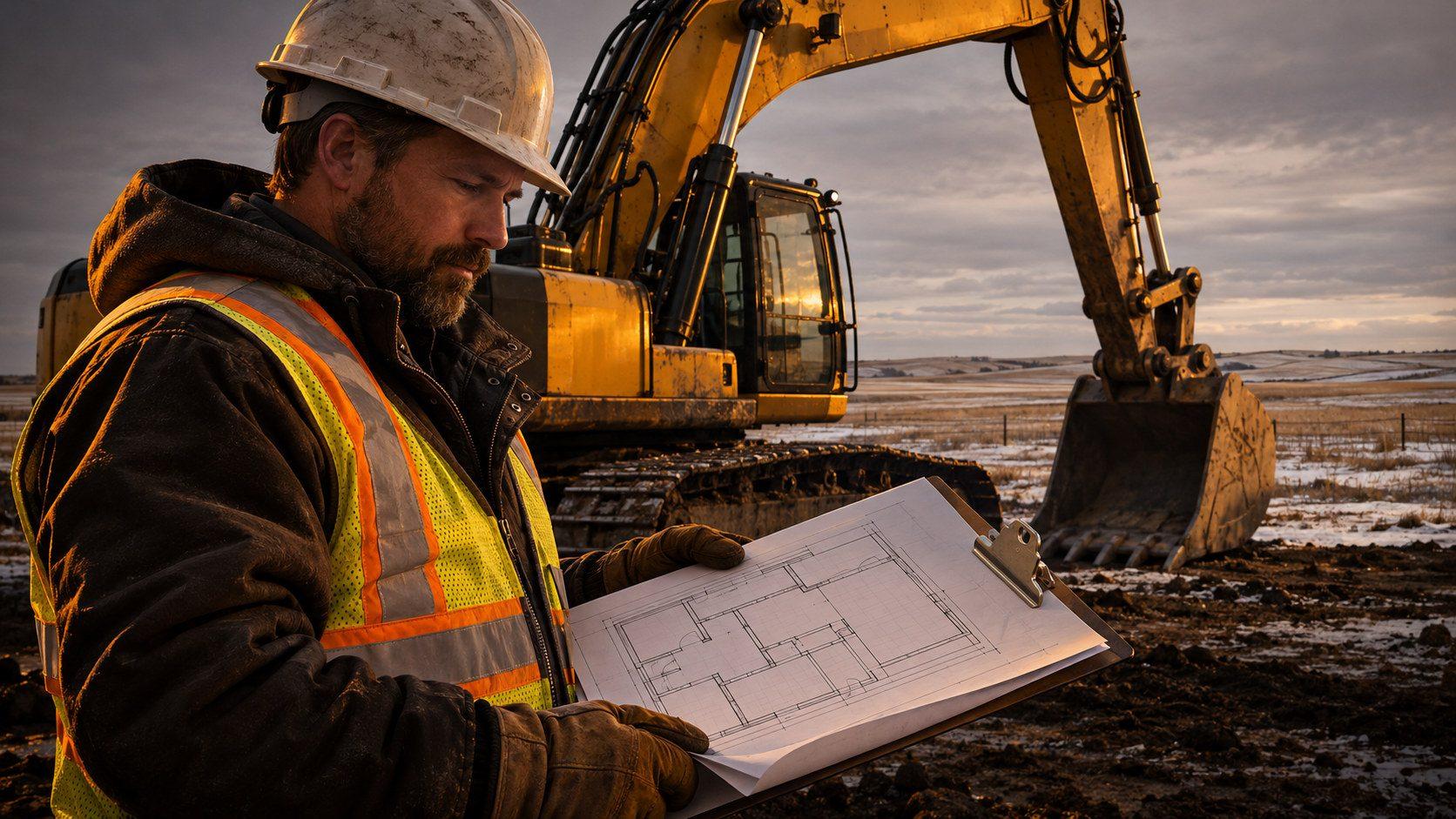
Yes. Construction arbitrage is legal in North Dakota. You hold the prime contract, your subs do the physical work, you keep the spread. That is legal - and it is how most general contractors in the state already operate. What you need is a contractor licence from the Secretary of State, workers' comp coverage through WSI (the state monopoly fund), and your trade subs each holding their own independent state licences.
One thing that stands out about North Dakota: no exam. Getting the statewide GC licence here is easier than most states. The compliance work is in the workers' comp and trade sub licensing, not in getting the licence itself.
Is construction arbitrage legal in North Dakota - what the law says
Construction arbitrage means you win the work, your licensed subs do it, and you keep the margin. Some people call it contractor arbitrage or construction dropservicing - it is the same model. The global legality picture covers why the structure is legal across the English-speaking world. It has worked this way in construction for decades.
North Dakota's specific picture: a statewide contractor licence from the Secretary of State under N.D.C.C. Chapter 43-07, four licence classes by project size, annual renewal, no exam, workers' comp through WSI only (a state monopoly), and state-level trade licensing for electrical and plumbing. The two main compliance risks are the WSI statutory employer rule and ensuring your trade subs hold their own independent licences.
The Secretary of State contractor licence
Under N.D.C.C. Chapter 43-07, any person or entity contracting for or advertising to do construction work in North Dakota on projects exceeding $4,000 must hold a contractor licence issued by the Secretary of State. The threshold applies to the combined value of labour and materials.
There is no state exam and no experience requirement for this licence. That is unusual. Most states require at least a business-and-law exam, often a trade exam on top. North Dakota skips both. The application goes through the FirstStop portal at firststop.nd.gov. You need a certificate of liability insurance and, if you have employees, a WSI verification showing you have workers' compensation coverage.
Licence classes under N.D.C.C. §§ 43-07-05 and 43-07-07:
- Class D - projects up to $100,000, initial fee $100
- Class C - projects up to $300,000, initial fee $225
- Class B - projects up to $500,000, initial fee $300
- Class A - unlimited, initial fee $450
Licences renew annually by March 1. Renewal fees are lower than the initial fees. If you are running a pure arbitrage operation and bidding jobs above $500,000, you need Class A. Most operators starting out take Class C or Class B and upgrade as the business grows.
Both prime contractors and subcontractors doing work in North Dakota need this Secretary of State licence if the value of their contract exceeds the threshold. Your prime licence does not cover subs - each sub needs their own.
WSI - the monopoly workers' comp fund
This is the part that trips people up.
North Dakota is one of four monopoly workers' compensation states in the country - the others are Ohio, Washington, and Wyoming. Private insurers cannot write workers' compensation policies here. All WC coverage goes through Workforce Safety and Insurance (WSI) at workforcesafety.com. If you have employees, they must be covered through WSI. If your subs have employees, those employees must be covered through WSI.
There is no alternative. A private WC policy from your home state does not satisfy North Dakota's requirement if you are doing North Dakota work. Out-of-state contractors need to open a WSI account before starting work in the state.
The statutory employer rule under N.D.C.C. § 65-04-26.2. This is what you need to know: a general contractor is liable for WSI premiums and any applicable penalty for an employee of a subcontractor or independent contractor that does not secure required WSI coverage. If a sub you hire has workers and those workers are not covered through WSI, WSI can pursue you for the obligation and any associated penalties.
The case law confirms this. In Brendel Construction v. WSI (N.D. Supreme Court, 2021 and 2022), WSI pursued the general contractor after finding that two of Brendel's subcontractors had uninsured employees performing North Dakota construction work.
The practical response is straightforward: before any sub starts work, verify that they have an active WSI account. WSI has an online employer verification tool at workforcesafety.com. That verification is your evidence that you did the right thing. Keep records.
If you are a sole operator with no direct employees - you just hold the contract and sub everything out - you may still need a WSI account as a sole proprietor depending on how North Dakota classifies your situation. Check with WSI directly before assuming you are exempt.
Independent contractor test
WSI presumes a person performing services for pay is an employee unless you prove otherwise. The burden is on the party claiming contractor status.
The test is the 20-factor framework under N.D. Admin. Code § 92-01-02-49, derived from the IRS's historical 20-factor model. It is a right-to-control analysis - the central question is the degree to which the hiring party controls the manner and means of the work, not just the result. Some factors carry more weight than others. North Dakota does not use an ABC test.
For construction arbitrage, the cleanest picture is subs who run their own businesses independently - their own WSI accounts, their own employees, their own tools and equipment, their own other clients. That is genuine contractor status and it is easy to document. The problems come when operators treat subs like employees in practice but classify them as contractors on paper. WSI actively audits this, and the case law shows they pursue it.
Electrical and plumbing trade licensing
Trade licensing in North Dakota is at state level for electrical and plumbing. HVAC varies by municipality.
Electrical. The North Dakota State Electrical Board (NDSEB) handles electrical contractor licensing under N.D.C.C. Chapter 43-09. An electrical contractor must have a licensed Master Electrician or qualified equivalent on the books. The contractor licence requires general liability insurance of at least $300,000 combined single limit per NDSEB requirements. As of May 1, 2026, all continuing education courses for North Dakota electricians must be based on the 2026 National Electrical Code - the board updated its CE requirements for the new code cycle.
Verify contractor and individual electrician licence status through the NDSEB's online database at ndseb.com before hiring any electrical sub.
Plumbing. The North Dakota State Plumbing Board (NDSPB) handles plumbing contractor licensing under N.D.C.C. Chapter 43-18. A plumbing contractor must have a licensed Master Plumber on staff. Applications go through the board at ndplumbingboard.gov. North Dakota has a reciprocal licence arrangement with South Dakota - a South Dakota-licensed plumbing contractor can apply for a North Dakota Master Plumber licence without re-sitting the exam. That is useful if you are building a cross-border sub network along the interstate corridor.
The rule that matters most. Both your electrical subs and plumbing subs must independently hold their own NDSEB and NDSPB licences. The Secretary of State contractor licence you hold does not cover them. Each sub carries their own. Verify before work starts, every time.
HVAC. There is no statewide HVAC contractor licence in North Dakota. HVAC is handled at city or county level. Check the local building department before hiring HVAC subs in any new city or county.
What makes North Dakota different
A few things worth flagging if you are coming from another state:
No exam. Most states require at least a business-and-law exam to get a general contractor licence. North Dakota does not. The licence application is straightforward - insurance certificate, WSI verification, fee, FirstStop portal. For someone setting up a new operation, this removes a significant barrier. It does not remove the other compliance requirements, but the licence itself is accessible.
WSI monopoly. Wyoming is the only other western state with this structure. If you are used to shopping the private market for workers' comp, that option does not exist in North Dakota. You have one place to go: WSI. The upside is simplicity - one carrier, one process. The downside is there is no competition on rates and no alternative if you have a complicated situation.
GC liability for sub's WSI gaps. Under N.D.C.C. § 65-04-26.2, your subs' WC failures are potentially your failures. That is a sharper rule than most states, where the statutory employer doctrine at least requires you to show you took reasonable steps before you get clear. Here the obligation is cleaner - verify every sub's WSI status before work, and keep the records to prove it.
Four licence classes by project size. Pick the right class for the work you are bidding. The class limits are hard limits under the statute, not advisory. Bidding a $400,000 job on a Class D licence ($100,000 limit) is not a technicality - it is a violation.
Running this in practice
Register with the Secretary of State via firststop.nd.gov. Pick the class that fits the size of work you are going after. Get your WSI account open at workforcesafety.com - even if you have no employees on day one, understand the system before you hire a single sub.
Before any sub starts work: verify their Secretary of State contractor licence, their WSI account status, and their NDSEB or NDSPB licence for electrical and plumbing. Keep copies. That is the full verification checklist for every sub, every job.
North Dakota is one of the more straightforward states for the construction arbitrage model once you understand WSI. No exam, four clean licence classes, annual renewal, and the trade licensing picture is state-level only for electrical and plumbing. The WSI statutory employer rule is the thing to build your process around - it is the main reason you cannot afford to skip sub verification.
For building the sub network itself, how to find subcontractors and how to vet subcontractors cover the practical side. On the insurance stack beyond workers' comp, what insurance you need for construction arbitrage covers the full picture. The 90-day plan is where to start if you are building from scratch.
Last checked: 7 November 2026.
Frequently asked questions
Is construction arbitrage legal in North Dakota?+
Yes. Holding the prime contract, using licensed and insured subcontractors to do the physical work, and keeping the margin between what the client pays and what the subs cost is legal in North Dakota. That is standard contracting practice. You need a contractor licence from the Secretary of State under N.D.C.C. Chapter 43-07 for projects over $4,000, workers' compensation coverage through WSI (the state's monopoly fund), and your electrical and plumbing subs each need their own independent state licences.
Does North Dakota require an exam to get a contractor licence?+
No. North Dakota is one of the few states that does not require a trade or business-and-law exam for the statewide general contractor licence. The licence comes from the Secretary of State under N.D.C.C. Chapter 43-07, and the application asks for a liability insurance certificate, WSI verification if you have employees, and the relevant fee. No exam, no experience requirement at state level. The competency requirement is effectively built into the insurance and WSI obligations.
What are North Dakota's contractor licence classes?+
The Secretary of State issues four classes. Class D covers projects up to $100,000, initial fee $100. Class C covers projects up to $300,000, fee $225. Class B covers projects up to $500,000, fee $300. Class A is unlimited, fee $450. Licences renew annually by March 1. Apply through the FirstStop portal at firststop.nd.gov. Source: N.D.C.C. §§ 43-07-05 and 43-07-07, Secretary of State.
What is WSI and why does it matter for construction arbitrage in North Dakota?+
WSI is Workforce Safety and Insurance - North Dakota's state-run workers' compensation fund. North Dakota is a monopoly WC state: private insurers cannot underwrite workers' compensation here. All coverage comes through WSI only. If you have employees or if your subs have employees, WSI coverage is required. Under N.D.C.C. § 65-04-26.2, a general contractor is liable for WSI premiums and any penalties for uninsured workers employed by a subcontractor or independent contractor on the job. That means your subs' WC gaps become your problem. Get WSI certificates from every sub before work starts.
Do subcontractors in North Dakota need their own licences?+
Yes. Electrical subcontractors must independently hold their own North Dakota State Electrical Board (NDSEB) contractor licence under N.D.C.C. Chapter 43-09. Plumbing subcontractors must independently hold their own North Dakota State Plumbing Board (NDSPB) licence under N.D.C.C. Chapter 43-18. The Secretary of State contractor licence you hold does not extend to your subs for trade work. Verify every trade sub's licence status before they step on site.
How does North Dakota classify independent contractors for workers' comp?+
WSI uses a presumption of employment: unless you can prove an independent contractor relationship under the common-law test, a person who performs services for pay is treated as an employee for WC purposes. The test is the 20-factor framework under N.D. Admin. Code § 92-01-02-49. Some factors carry more weight than others. The burden of proving contractor status sits with the party claiming it. This is not an ABC test - it is a right-to-control analysis. If a sub has their own WSI account and their own employees covered, that is the cleanest evidence of genuine contractor status.
What is the statutory employer rule in North Dakota?+
Under N.D.C.C. § 65-04-26.2, general contractors are liable for WSI premiums and penalties when a subcontractor or independent contractor does not have required WC coverage for their workers. If a sub's employee is injured on your job and that sub has no WSI account or has not paid their premiums, WSI can come after you as the general contractor. The practical protection is to verify that every sub has a current, active WSI account before work begins - and to collect evidence of that before each job starts.
Is construction arbitrage the same as construction dropservicing in North Dakota?+
Yes - same model, different name. Construction dropservicing, contractor arbitrage, and construction arbitrage all describe the same structure: you hold the prime contract, licensed subs do the physical work, you keep the spread. The North Dakota compliance requirements - SOS contractor licence, WSI workers' comp, NDSEB electrical sub licences, NDSPB plumbing sub licences - apply equally regardless of what you call it.
What happens if I operate without a contractor licence in North Dakota?+
Contracting above the $4,000 threshold without a Secretary of State licence is a violation of N.D.C.C. Chapter 43-07. The Secretary of State can pursue administrative enforcement, and operating without coverage while you should have WSI creates its own penalties on top. Beyond that, local building departments can deny permits and issue stop-work orders. The licence is cheap and there is no exam - there is no good reason to operate without one.

Mohamed El HadriCo-Founder
I'm a co-founder of several construction companies. I built a construction business from a 30-van operation into a lean model with 1,500+ subcontractors in the database - winning the work as the main contractor, subbing it out, and running it as a system from a laptop across multiple countries. I write this site from what actually works.
@mointhemarket · 35.1k followers on Instagram →Run the model with people who already do
Reading the method is step one. Inside Construction Arbitrage Players you connect with players from around the world who run construction arbitrage every day and make real money from it - share your deals, get answers, and get in the game. Founding-member access is open now.
For the operator life and the inside story, see Contractor Club.
THE EDGE - the listening book on how the money really moves through a contracting business - is out now. Listen free, or see what is inside.
The Family Secret - how construction arbitrage really works - is coming soon.
A construction business built this way is a sellable asset
Systems, subs and margin - that is exactly what buyers pay for. If you own a construction or trade business and the exit is on your mind, list it on ContractorExit, the marketplace for buying and selling trade businesses. The valuation is free, so you find out what it is worth before you decide anything.
Get the Construction Arbitrage playbook
One sharp email a week: real numbers, live deal breakdowns, and the systems that let you run jobs you never visit. No fluff, unsubscribe anytime.