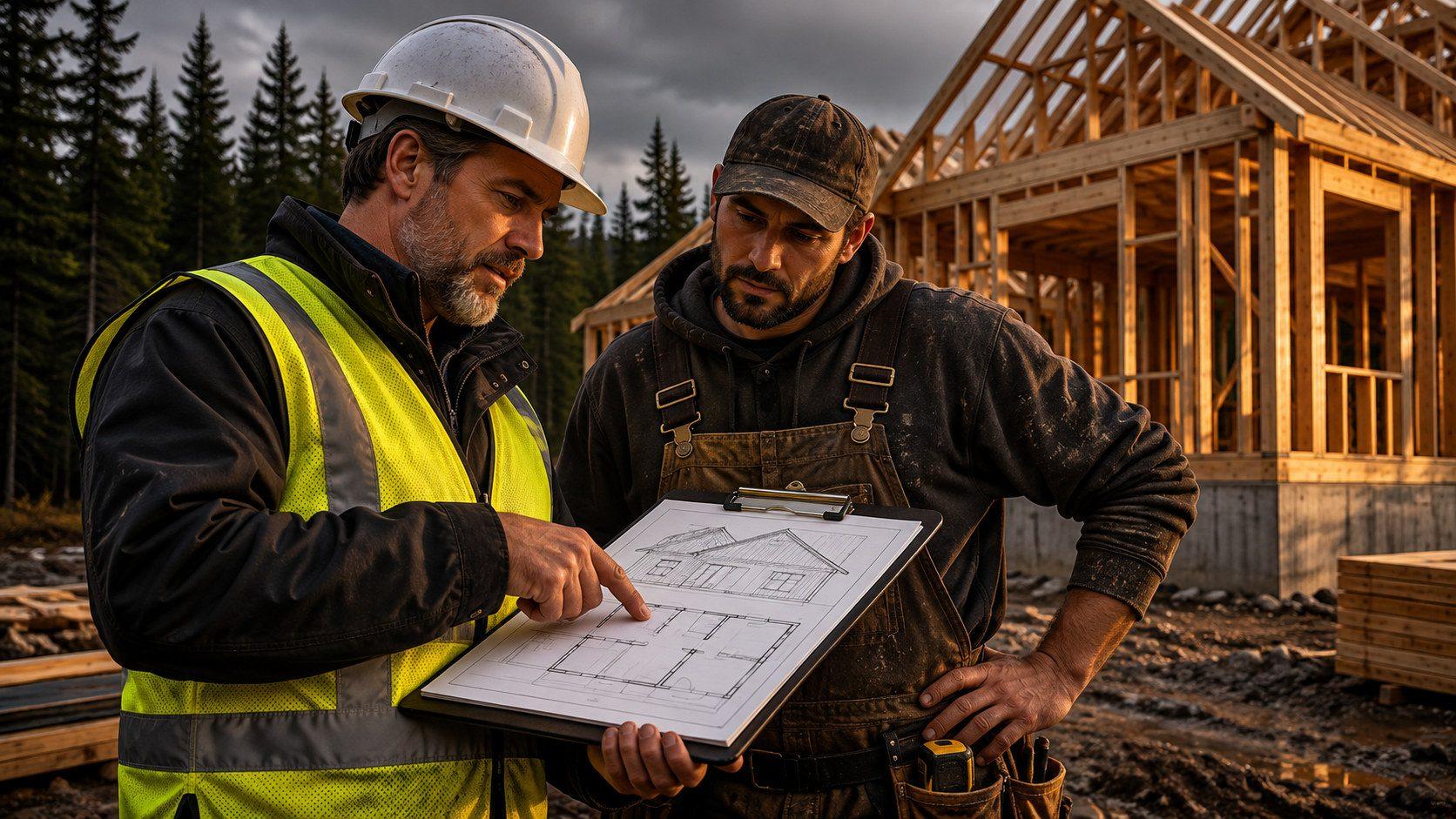
Yes. Construction arbitrage is legal in New Brunswick. You hold the contract, your licensed subs do the work, you keep the spread. New Brunswick has no provincial general contractor licence for renovation or commercial work - which keeps the entry bar lower than most Canadian provinces. The compliance layer that does exist is specific: business registration, WorkSafeNB once you have three workers, and licensed tradespeople on every regulated trade.
I have run this model across multiple markets and I work with operators building it in Canada. Here is what the New Brunswick rules actually look like on the ground.
Is construction arbitrage legal in New Brunswick - what the law says
Construction arbitrage means winning the prime contract, subcontracting the physical work to licensed trades, and keeping the margin between the two prices. Some people call it contractor arbitrage or construction dropservicing - same model, different name. The legal position globally is that the structure is standard contracting practice, completely legal, and the real question is compliance.
In New Brunswick, there is no law that prevents a main contractor from subcontracting all physical work. That is how the majority of commercial builds, renovation projects and residential construction are delivered in this province. The main contractor wins the job, manages the project and uses licensed tradespeople to do the physical work. The province's rules are built around that model.
The Canada country-level overview covers the federal picture - no national GC licence, T5018 reporting for sub payments, federal GST/HST registration. This post goes one level deeper into New Brunswick specifically. If you are comparing provinces, the Ontario post covers the HCRA licence for new homes and the WSIB system, which is a heavier compliance picture. New Brunswick is simpler.
No provincial GC licence for renovation or commercial work
This is the most useful point for anyone looking at New Brunswick. There is no provincial general contractor licence, no provincial registration, and no provincial body you need to register with to operate as a main contractor in renovation or commercial construction. New Brunswick is one of a handful of Canadian provinces - alongside Saskatchewan and Nova Scotia - where general contracting for renovation and commercial work is not provincially regulated.
The Canadian Home Builders' Association of New Brunswick has been lobbying for a mandatory contractor registry, wanting contractors to carry commercial liability insurance, WorkSafeNB coverage, and CRA registration. As of this writing, no legislation has passed. The province has not created a contractor registry or home improvement contractor registration programme. The industry push is real and worth monitoring, but right now there is no provincial licence to obtain for general contracting work.
What you do need: business registration, WorkSafeNB coverage, and licensed tradespeople for regulated trade work. That is the whole compliance stack for the main contractor role in New Brunswick.
Business registration with Service NB
Before you take contracts, register your business with Service NB. The Corporate Registry portal is at snb.ca. The key step:
- Register your business name under the Partnerships and Business Names Registration Act within two months of starting to operate under that name
- Choose your structure: sole proprietorship, partnership, or incorporation
- If you incorporate a New Brunswick company, file through the Corporate Registry at snb.ca
Out-of-province corporations carrying on business in New Brunswick must also register as an extra-provincial corporation within 30 days of first operating in the province.
Once registered, contact the CRA at 1-800-959-5525 to activate your Business Number and register for HST once revenue exceeds $30,000.
Licensed trades in New Brunswick - who must be qualified
Regulated trade work in New Brunswick requires a licence issued by Technical Inspection Services (TIS), part of the Department of Justice and Public Safety. Applications and renewals go through the TISConnect portal at tisconnect.gnb.ca, reachable at 1-888-659-3222.
As the main contractor, every sub doing regulated trade work must independently hold their own TIS licence. Your general contractor role does not cover them.
Electrical: An Electrical Contractor Licence is required to obtain electrical wiring permits and carry out electrical installations. To qualify, the applicant must hold a New Brunswick Electrician's Licence, have two years of experience as a journeyman electrician, and pass a contractor examination. The fee is $400 for a new contractor licence. The individual Electrician's Licence is $50 and requires a New Brunswick Certificate of Qualification in the electrical trade. The legal basis is the Electrical Installation and Inspection Act, Regulation 84-165, which adopts the CSA C22.1-24 Canadian Electrical Code (26th Edition) with New Brunswick modifications.
Plumbing: A Plumbing Contractor Licence ($400) requires a New Brunswick Plumber's Licence, two years as a journeyman plumber, and a contractor examination. The individual Plumber's Licence is $50 and requires a Certificate of Qualification. Apply at tisconnect.gnb.ca.
Gas: Gas contractor work requires a gas business licence through Technical Inspection Services. Gasfitter certification is separately required for individuals doing gas installation work.
Verify every trade sub's licence at tisconnect.gnb.ca before they start work. Only licensed contractors can apply for trade permits. If an unlicensed tradesperson does the work, the permit cannot be pulled and the work cannot be inspected.
WorkSafeNB - mandatory for construction employers
WorkSafeNB provides workers' compensation coverage in New Brunswick under the Workers' Compensation Act. Construction is a mandatory industry.
When you must register: You must register with WorkSafeNB within 15 days of becoming an employer. Mandatory coverage applies when you have three or more workers at any time during the year. This is a lower threshold than you might expect - three workers is not a large crew.
Clearance certificates: Before every subcontractor starts on your site, request a WorkSafeNB clearance certificate from them. This confirms they are registered and in good standing. Request clearance through the MyServices portal at ws-ts.nb.ca. Keep a copy on file for every sub, every job.
Unregistered subs: If a sub is not registered with WorkSafeNB because they have fewer than three workers, WorkSafeNB will assess you on the contract value. The rates are: labour-only contracts at 100% of contract value, labour and materials at 50%, hired equipment at 25%. You can recover the assessed portion from the sub, but you are on the hook to WorkSafeNB first. The safe move is always to verify clearance before they start.
Independent contractor status: WorkSafeNB looks mainly at control - who controls how the work is done. Tools, financial risk, and whether the sub has multiple clients also factor in. A signed IC agreement won't override the actual working relationship if the sub looks like your employee in practice. Register your own subs with their own WC accounts and get clearance - that is cleaner than arguing IC status after an incident.
WorkSafeNB can be reached at 1-800-999-9775 or at worksafenb.ca.
HST at 15%
New Brunswick uses the Harmonized Sales Tax at 15%, made up of 5% federal and 10% provincial. Construction services are taxable at 15%.
For registration: once your annual revenue from taxable supplies exceeds $30,000 in any four consecutive calendar quarters, register with the CRA and begin charging HST on invoices. Once registered, you claim input tax credits on the HST your subs charge you.
For sub payments: the federal T5018 reporting obligation applies when you pay subs more than $500 per job for construction services, where construction represents more than 50% of your business income. File T5018 slips with the CRA at year end. The Canada overview covers the T5018 system in detail.
The Construction Remedies Act and payment holdbacks
New Brunswick replaced its Mechanics' Lien Act with the Construction Remedies Act for all contracts entered on or after November 1, 2021.
The key point for the main contractor on residential projects: you must give the owner a Notice to Owner (Form 9) naming the subcontractors who will supply services or materials on the job. This form also notifies the owner of their holdback obligation under section 34 of the Act - typically 10% of each payment. The holdback protects the sub's payment rights. If you skip the Notice to Owner, lien rights of your subs are preserved regardless.
As the main contractor, you are also the one managing holdback releases and your own lien rights against the owner. Get construction-specific legal advice before your first significant contract in the province - the payment rules are different from what you may be used to in other jurisdictions.
The compliance checklist for New Brunswick
Before you take your first contract in New Brunswick:
- Register your business with Service NB Corporate Registry (snb.ca)
- Activate your CRA Business Number and register for HST once you exceed $30,000 annual revenue
- Register with WorkSafeNB within 15 days of becoming an employer (worksafenb.ca, 1-800-999-9775)
- Request a WorkSafeNB clearance certificate from every sub before they start - keep it on file
- Verify every electrical sub's TIS licence at tisconnect.gnb.ca
- Verify every plumbing sub's TIS licence at tisconnect.gnb.ca
- Verify every gas sub's TIS gas licence at tisconnect.gnb.ca
- Pull the municipal building permit for every job that requires one
- On residential projects, give the owner a Notice to Owner (Form 9) naming all subs
- File T5018 slips at year end for every sub paid more than $500 on a construction contract
The model is legal. The compliance is manageable. The operators who run into trouble in New Brunswick are the ones who use unlicensed tradespeople on regulated work, or who skip the WorkSafeNB clearance step and find themselves assessed on a sub's contract value after something goes wrong.
If you are building the subcontractor network you need to run this in New Brunswick, finding licensed electrical and plumbing subs outside Moncton and Fredericton takes time. That is usually the first real bottleneck.
The payment mechanics - structuring deposits, staged invoicing, getting paid before the client pays you - that is what THE EDGE covers. Free to start, it is a listening book.
Last checked: 25 November 2026.
Frequently asked questions
Is construction arbitrage legal in New Brunswick?+
Yes. Construction arbitrage is legal in New Brunswick. Winning the prime contract, subcontracting the physical work to licensed trades, and keeping the spread between the two prices is exactly how most general contracting already works in this province. New Brunswick has no provincial general contractor licence for renovation or commercial work. The real requirements are Service NB business registration, WorkSafeNB coverage once you have three or more workers, licensed trades doing each regulated trade, and municipal building permits.
Do I need a GC licence to do construction arbitrage in New Brunswick?+
No. New Brunswick has no provincial general contractor licence. There is no provincial body you register with as a general contractor for renovation or commercial construction. What you need is business registration with Service NB, WorkSafeNB registration once you hit three workers, and independently licensed tradespeople for electrical, plumbing and gas work. That is the full picture for general contracting in this province.
What is the HST rate for construction in New Brunswick?+
The HST rate in New Brunswick is 15%, made up of 5% federal and 10% provincial. Construction services are taxable at 15% HST. Register for GST/HST with the CRA once your annual revenue exceeds $30,000 in four consecutive calendar quarters.
Do my electrical subs need to be licensed in New Brunswick?+
Yes. Electrical contractor work in New Brunswick requires a licensed Electrical Contractor, issued by Technical Inspection Services. The contractor must hold a New Brunswick Electrician's Licence, have two years as a journeyman electrician, and pass a contractor exam. Only a licensed electrical contractor can apply for a wiring permit. Verify every electrical sub at tisconnect.gnb.ca before they start.
When do I need to register with WorkSafeNB?+
You must register with WorkSafeNB within 15 days of becoming an employer. Mandatory coverage applies when you have three or more workers at any time during the year. Before every sub starts on your site, request a WorkSafeNB clearance certificate. If a sub is not registered, they can be treated as your worker for compensation purposes, and WorkSafeNB will assess you on the contract value.
Is construction arbitrage the same as construction dropservicing in New Brunswick?+
Yes - same model, different name. Construction dropservicing, contractor arbitrage and construction arbitrage all describe the same structure: you hold the prime contract, your licensed subs do the physical work, you keep the margin. All the same New Brunswick compliance requirements apply - Service NB registration, WorkSafeNB, licensed tradespeople, municipal permits, and 15% HST - regardless of what you call it.

Mohamed El HadriCo-Founder
I'm a co-founder of several construction companies. I built a construction business from a 30-van operation into a lean model with 1,500+ subcontractors in the database - winning the work as the main contractor, subbing it out, and running it as a system from a laptop across multiple countries. I write this site from what actually works.
@mointhemarket · 35.1k followers on Instagram →Run the model with people who already do
Reading the method is step one. Inside Construction Arbitrage Players you connect with players from around the world who run construction arbitrage every day and make real money from it - share your deals, get answers, and get in the game. Founding-member access is open now.
For the operator life and the inside story, see Contractor Club.
THE EDGE - the listening book on how the money really moves through a contracting business - is out now. Listen free, or see what is inside.
The Family Secret - how construction arbitrage really works - is coming soon.
A construction business built this way is a sellable asset
Systems, subs and margin - that is exactly what buyers pay for. If you own a construction or trade business and the exit is on your mind, list it on ContractorExit, the marketplace for buying and selling trade businesses. The valuation is free, so you find out what it is worth before you decide anything.
Get the Construction Arbitrage playbook
One sharp email a week: real numbers, live deal breakdowns, and the systems that let you run jobs you never visit. No fluff, unsubscribe anytime.