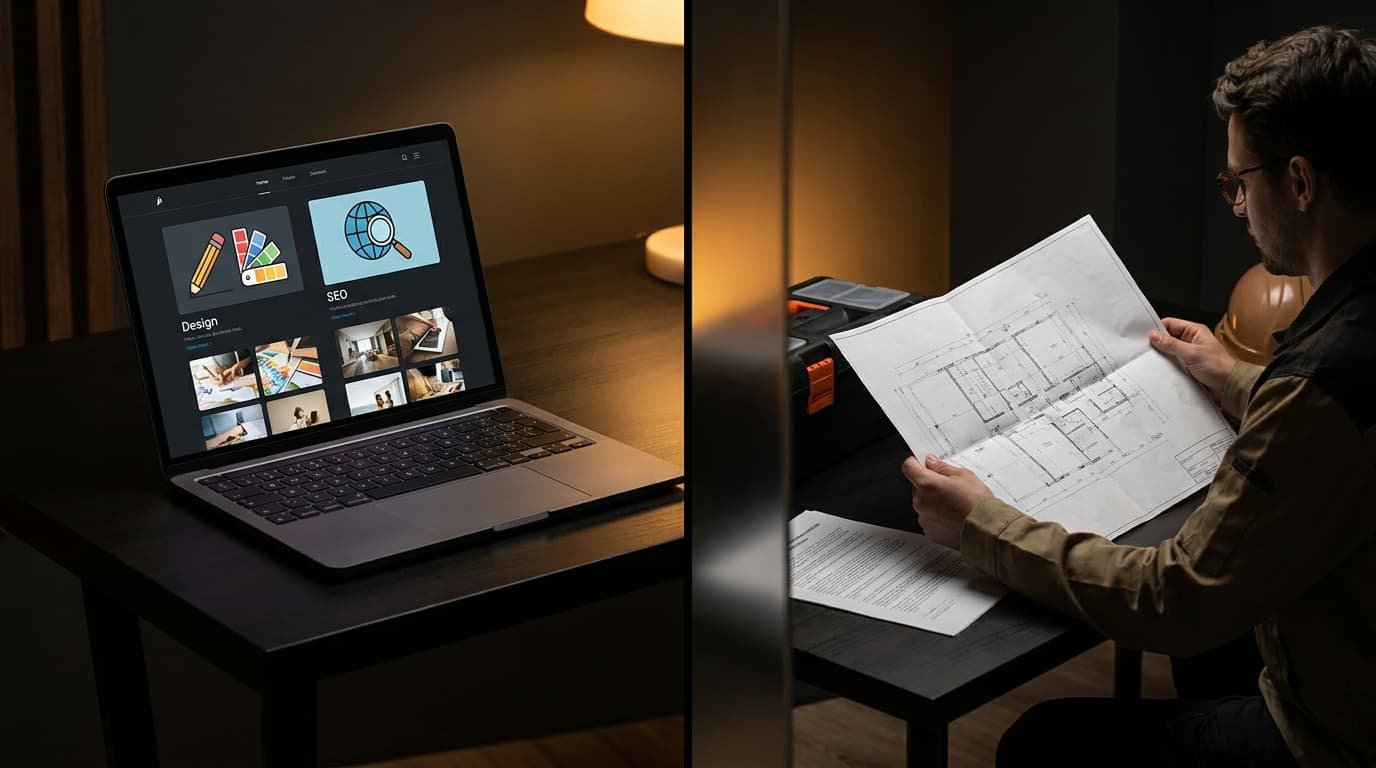
Construction dropservicing pays more per deal. Digital drop servicing can post a higher gross percentage on small-ticket work - charging two or three times what a freelancer costs is common. But construction jobs run $5,000 to $50,000 each, and the spread on one renovation covers what most digital operators earn in two months.
Construction dropservicing is another name for construction arbitrage - the same model also called contractor arbitrage. You win the job as the main contractor, your subs do the physical build, and you keep the margin. If you landed here from the digital drop servicing world, what is construction dropservicing explains the full mechanics before you compare the two.
What the digital drop servicing spread actually looks like
The headline numbers in digital drop servicing look good. Charge a client $1,000 for a logo and brand kit, pay a designer on Fiverr $300, keep $700. That is a 70% gross margin on paper.
The problem is deal size. Most digital drop servicing operates in the $200 to $2,000 range per project. A solid month for a beginner running ten projects looks like $3,000 to $7,000 gross - before ad spend, platform fees, revision rounds, and the occasional chargeback.
Established operators who have moved up to retainer-based work do better. A content agency reselling $5,000 monthly retainers and marking up 40% can pull $2,000 gross per client. But getting there requires a built reputation, vetted freelancers who do not flake, and a client base that stays month-to-month. That takes time.
The other pressure eating at those margins: AI. Basic copywriting, stock graphic design, simple data entry - the floor has dropped fast. Clients who paid $500 for a blog post two years ago are asking why they cannot get it for $50 with an AI tool. The operators holding their margins have moved into technical niches - complex video production, paid media management, AI workflow automation. Those niches are real. They are also not the easy-entry categories most drop servicing courses lead with.
What construction dropservicing actually pays
Construction jobs are larger - fundamentally, structurally larger.
A bathroom renovation runs $8,000 to $20,000 in most Western markets. A kitchen runs $15,000 to $40,000. A painting job on a three-bedroom house runs $3,000 to $6,000. Even small maintenance jobs - fixing a leak, replacing a fence, fitting a new front door - often run $500 to $2,000.
At 25 to 35% gross margin, a single bathroom renovation at $15,000 returns $3,750 to $5,250 gross from one job. Two of those a month and you are at $7,500 to $10,500 gross before your own costs. The profit margins in construction arbitrage are not higher in gross percentage than digital - but the cash per deal is in a different category.
The cost stack underneath is real: your insurance, admin time, site visits or video calls to scope the job, chasing slow-paying clients, occasional variation orders. Net after those costs on a well-run operation runs 15 to 25% of revenue. That still puts more cash in your account per transaction than most digital work at a higher gross percentage.
The comparison that actually matters - cash per deal, not percentages
Gross percentage alone tells you nothing useful. What matters is cash in your account at the end of the month. Here is a rough side by side using realistic but not guaranteed figures:
Digital drop servicing - active operator, 10 projects a month:
- Average deal: $800
- Average gross margin: 55%
- Monthly gross: $4,400
- Less platform fees, ad spend, revisions, chargeback risk
- Realistic monthly net: $2,500 to $3,500
Construction dropservicing - active operator, 4 jobs a month:
- Average deal: $10,000
- Average gross margin: 28%
- Monthly gross: $11,200
- Less insurance, admin, site time, slow-pay gaps
- Realistic monthly net: $7,000 to $9,000
Your numbers will be different. Deal size varies by market. Margin varies by how well you price. But the structural gap is real. Construction wins on cash per transaction - and that gap widens as you grow, because the deal size in construction scales faster than the deal size in digital gig work.
Why AI changes the digital maths - and why construction is immune
I will say plainly what the digital drop servicing forums avoid: AI has cut the floor out from under the entry-level niches.
Generic blog writing, basic logo design, simple data work, stock photo sourcing - these are being commoditised faster than any operator can pivot. Clients have learned to produce adequate versions of these themselves in minutes. The freelancers who supply you are dropping prices to compete. Margins that looked healthy two years ago are under pressure that is structural, not cyclical. It is not coming back.
Construction has no equivalent. A subcontractor cannot be replaced by a language model. No AI is replumbing a bathroom, reroofing a terrace, or rewiring a commercial unit. If anything, the trades are undersupplied in most Western markets - that structural shortage is what makes the spread durable. The compliance barrier that entry-level drop servicers never face in digital work (no licensing, no insurance requirement in most cases) is also the competitive moat that keeps construction margins from being competed away.
The local moat that digital cannot match
Digital drop servicing is a global market. Your competitor can be anywhere. Your client can compare-shop across the entire internet in seconds. That permanent price pressure is the reason margins in saturated digital niches keep compressing.
Construction is local. A homeowner in Leeds or Dallas is not hiring a company that cannot send a trade to their house. Your competitive set is local. Your reputation travels through word-of-mouth, referrals, and local directories - not a global freelance platform. Once you have the right subs in a market and a record of clean deliveries, you have a real edge that does not erode overnight.
I noticed this clearly when I was building from my first handyman jobs into a model running 1,500-plus subcontractors across markets. The local jobs were stickier than any digital work I could have resold. Once you have the right sub in a market, that relationship is yours. No one on the other side of the world can take it from you.
For a deeper look at how the two models differ structurally - not just on money - the construction arbitrage vs drop servicing comparison covers both in detail.
Who should choose which
Choose digital drop servicing if you are entirely remote with no access to any local market, you already have freelancer relationships and a working client base, or you want the lowest-cost, lowest-compliance starting point possible.
Choose construction dropservicing if you have access to a local market - any town, any city - you want higher cash per deal, you want a model that AI cannot undercut in three years, or you are willing to get licensed, insured, and learn how to price physical jobs.
They are not mutually exclusive at the start. But they reward focus. Most people who have made real money from construction arbitrage were doing something else - digital agencies, drop servicing, freelancing - and made the switch when they saw what the cash per job in construction changed. The best construction niches to start with are a practical next read if you are leaning that direction.
Where to go from here
If you are leaning toward construction dropservicing, the move is to pick a local market, find out what licence you need in your state or country, and start quoting. The Construction Arbitrage Players community on Skool is where operators are running the model today - different trades, different cities, real numbers on what is working.
And when it ships, THE FAMILY SECRET - How Construction Arbitrage Really Works will be the complete inside picture of how this model runs at real scale, from the first handyman job to 1,500-plus subs. Coming soon.
Last checked: 29 July 2026.
Frequently asked questions
Is construction dropservicing the same as construction arbitrage?+
Yes. Construction dropservicing and construction arbitrage - also called contractor arbitrage - are the same model under different names. You win work as the main contractor, subcontract the physical build to tradespeople, and keep the spread between what the client pays and what your subs charge. The dropservicing label came from the digital gig world; the mechanics are identical.
Which has higher profit margins - digital drop servicing or construction dropservicing?+
Digital drop servicing can post a higher gross percentage on small-ticket work - 50 to 70% is common when you charge 2x to 3x what you pay a freelancer. Construction dropservicing typically runs 25 to 35% gross. But construction deals are ten to twenty times larger per transaction, which means far more cash from each job - that is the number that actually matters.
Can I switch from digital drop servicing to construction dropservicing?+
Yes, and many operators do exactly that. The skills overlap: client management, quoting, sourcing, and quality control at a distance all transfer. The extra steps in construction are getting licensed and insured in your market and building a sub network instead of a freelancer list. The how-to-start guide covers both.
Do I need construction experience to start construction dropservicing?+
No. You need to understand a job well enough to quote it and manage client expectations - not to perform the physical work. That knowledge builds quickly. Plenty of people have moved into construction dropservicing from digital agencies, recruitment, and e-commerce with zero trade background.
Is digital drop servicing being killed by AI in 2026?+
AI is compressing margins on commoditised digital services - basic copywriting, generic design, simple data entry. Operators in technical niches like video production or marketing automation report margins holding or improving. If you planned to resell basic writing or design work, that margin has been squeezed hard. Construction has no equivalent AI pressure - a sub cannot be replaced by a language model.

Rob LazFounder
I'm a founder of several construction companies and of Contractor Club. I run a seven-figure construction business remotely - I haven't touched a tool in two years - and I teach others how to do the same.
@roblaz__ · 20k followers on Instagram →Run the model with people who already do
Reading the method is step one. Inside Construction Arbitrage Players you connect with players from around the world who run construction arbitrage every day and make real money from it - share your deals, get answers, and get in the game. Founding-member access is open now.
For the operator life and the inside story, see Contractor Club.
THE EDGE - the listening book on how the money really moves through a contracting business - is out now. Listen free, or see what is inside.
The Family Secret - how construction arbitrage really works - is coming soon.
A construction business built this way is a sellable asset
Systems, subs and margin - that is exactly what buyers pay for. If you own a construction or trade business and the exit is on your mind, list it on ContractorExit, the marketplace for buying and selling trade businesses. The valuation is free, so you find out what it is worth before you decide anything.
Get the Construction Arbitrage playbook
One sharp email a week: real numbers, live deal breakdowns, and the systems that let you run jobs you never visit. No fluff, unsubscribe anytime.