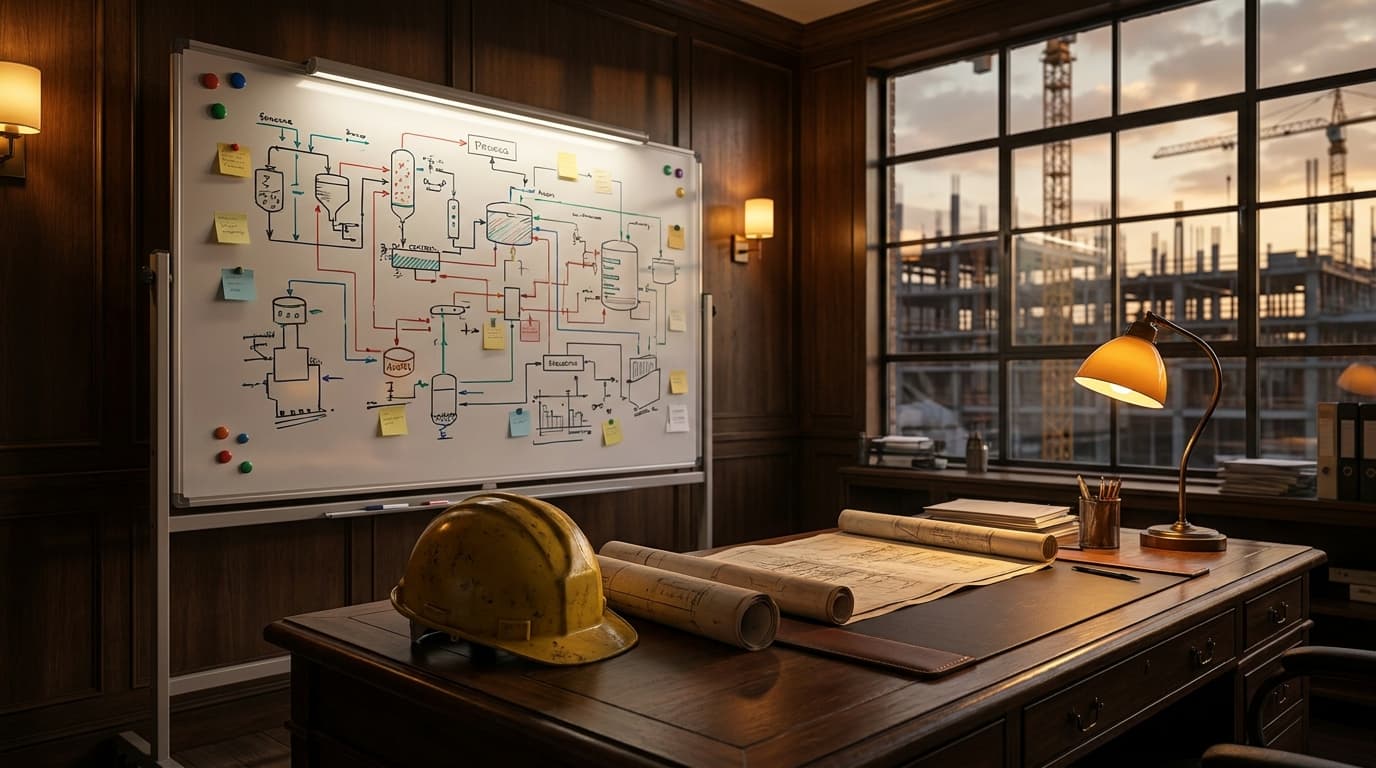
An industrial engineer looks at a construction business and sees inputs, bottlenecks, and a doorway - not jobs. That framing is what separates a construction business that scales from one that only grows until the owner breaks. My business partner Mo El Hadri is an industrial engineer, and the first time he mapped my business on a whiteboard, I understood construction arbitrage for the first time.
I had been doing it for years. I was just doing it wrong.
What the industrial engineer sees that the tradesman misses
I was a one-man band when I met Hadri. I saw jobs. I priced them, I did them, I invoiced them. When there were more jobs than I could handle myself, I brought in a handyman, then a plumber, then more trades. Eventually we had thirty vans on the road and I was still seeing jobs - just thirty of them at once.
Hadri saw something different from the first day he looked at the business. He did not ask how many jobs we had. He asked where the work came from, what happened to it after it arrived, and where the money got stuck.
He was asking about inputs, processes, and outputs. He was looking for the bottleneck.
An industrial engineer is trained to look at any production system and find the constraint that limits everything downstream. Fix the constraint and the whole system speeds up. Touch anything else first and you are tightening the fan belt on a car with a cracked engine block.
In a construction business, the constraint is almost always the owner.
Every quote goes through the owner. Every client call goes through the owner. Every decision about which sub to use, when to book them, whether the variation is worth taking on, goes through the owner. The business cannot grow faster than the owner can process decisions. And the owner is already at capacity before breakfast.
The five parts Hadri split the business into
The first time Hadri sat down with my business he drew five boxes on a page.
- Winning the work
- Pricing the work
- Doing the work
- Checking the work
- Getting paid for it
Then he asked me which ones needed me specifically. Not which ones I was doing - he already knew the answer to that - but which ones actually required me, as opposed to a process, a person, or a rule.
The honest answer was one. Winning the work. The relationship in the first meeting, the trust, the referral. That part carried my name. The other four did not need to.
That is the IE view of a construction business: the owner is the input filter, and the owner's job is to control the doorway. Everything else - the doing, the checking, the billing, the coordinating - is a process that can be documented, handed to someone better at it, and run without the owner standing in the middle of it.
Construction arbitrage is what happens when you apply that logic: win the work as the main contractor, hand the doing to a subcontractor who is better at it than you, and make the profit on the spread. It is industrial engineering applied to a building site.
What a bottleneck actually looks like on a job
The thing about bottlenecks is that they do not look like problems at first. They look like you being busy.
I was always busy. Full diary, phone always on, never a quiet moment. I thought that meant the business was healthy. Hadri pointed out that it meant the opposite. A system where the owner is always busy is a system where the owner is the bottleneck. Busy is not the same as producing. Busy is what happens when the work cannot move forward without you.
On a real job, the bottleneck shows up like this: the sub is on site and needs a material approval. They cannot proceed until the owner approves it. The owner is on another call. The day rate is running. The client is waiting. One decision from one person is holding up the whole job.
Multiply that by ten jobs and you have a construction business at capacity - not because there is no more work, but because the owner cannot process ten decisions an hour faster than the work demands them.
The IE fix is not to work faster. It is to remove the decision from the critical path. Write the rule once - materials from the approved list under $500 are approved without me - and the job moves without you. The bottleneck shifts. You find the next one and do it again.
Hadri has done this across every process in the business we built together. If you want to understand who he is and what he actually built before he taught any of this, I wrote that up here.
The doorway: the one thing that does need you
Here is the part that took me the longest to understand.
Hadri kept saying that the goal was to own the doorway, not to own the process. I kept trying to understand the processes - the spreadsheets, the schedules, the sub vetting. He kept dragging me back to the doorway.
The doorway is whoever the client calls. Whoever the client trusts. Whoever's name is on the quote.
In construction, the client does not hire the best tradesman. They hire the company they believe will show up, finish the job, and stand behind it. They hire the name on the van. They hire the voice on the phone that answered when they called. That is the doorway. And the doorway carries value that cannot be subcontracted.
The sub does the work. You hold the doorway.
This is the thing that most people in construction miss when they hear "subcontract everything". They think it means step back and let someone else be responsible. It does not. It means hold the doorway - the client relationship, the price, the choice of sub - and hand the execution to someone who is faster and cheaper at it than you are. The spread between what the client pays you and what you pay the sub is your return for holding the doorway.
Every construction company that gets to serious size is doing exactly this. The main contractor on a commercial site is an industrial engineer with a project management layer: they hold the doorway to the client, they coordinate the inputs, they manage the bottlenecks, and they collect the margin. The trades do the work. That is not a new model. Hadri just showed me that you can run it from a much earlier stage than most people think.
What I changed after I understood it
The construction arbitrage delegation post covers the mechanics in detail - the four handovers in order and how to test whether the business is actually running without you. What I want to add here is what changed in my head first.
I stopped thinking about the job. I started thinking about the inputs. What work was coming in, where it came from, and whether the process between the doorway and the payment was slow because of a bad sub or because of a decision that did not need to be mine.
I started asking Hadri's question every time a problem landed on my desk: which box is this in - winning, pricing, doing, checking, or getting paid - and does it actually need me?
Most problems, once I asked that, turned out to be in the doing or the checking. Which meant they were not mine. They belonged to the process, and the process had a fix.
That shift - from job-thinking to process-thinking - is the fastest way I can describe what an industrial engineer brings to a construction business. It does not require an engineering degree. It requires being willing to look at the business as a system and find the constraint instead of just working harder around it.
If you want to get off the tools and stop being the bottleneck in your own business, the how to get off the tools post is the place to start. And the systems and tools stack is what holds the process together once you have handed the decisions over.
You are not the worker in your business. You are the doorway. The moment you figure out which one you are, everything else gets easier to hand over.
One way to try the model before you change anything
If you want to feel the inputs-bottleneck-doorway problem before you risk a real job, play the free construction arbitrage game. It simulates three months of maintenance jobs with real scheduling decisions, sub choices, and cash flow that catches most people out. Hadri built the scoring from what actually happened to us, and you will see the bottleneck appear on day fifteen without needing to wait for it to happen in your own business.
The broader money thinking - payment terms, how to hold the spread, how to make the doorway pay on the way out as well as the way in - Hadri works through in his listening book THE EDGE. Free to start. Two of its five parts are specific to the UK building game, which is worth knowing if you are reading this from elsewhere: those chapters are a model, not your law.
If you want him in the room directly, here is what his mentorship looks like.
Frequently asked questions
What does an industrial engineer do differently in a construction business?+
An industrial engineer looks at the business as a system with inputs, processes, and outputs. They identify the bottleneck - the one constraint limiting throughput - and work to remove it before touching anything else. In construction, that usually means the owner. The owner is the bottleneck who every decision, quote, and problem flows through. Remove the owner from the critical path and the business scales. Leave them in it and the business has a ceiling.
What is the doorway in construction arbitrage?+
The doorway is whoever controls the flow of work into the business. Clients do not hire the tradesman who is cheapest or fastest. They hire the name they trust, the company they can call. That company controls the doorway. Whoever holds the doorway decides what work comes in, what price it goes out at, and what margin stays. In construction arbitrage, you are the doorway. You win the work and subcontract the doing.
What is the biggest bottleneck in a small construction business?+
Almost always the owner. Every quote has to go through them. Every client call. Every decision about which sub to use. The owner is the system's weakest point not because they are bad at what they do but because they are the only person doing it. Remove yourself as the bottleneck by documenting the process, delegating the decision, and paying for the outcome rather than the hour.
Can you apply industrial engineering thinking without an engineering degree?+
Yes. The concepts are not complicated. Map what comes into your business, what transforms it, and what comes out. Find the one step that slows every other step. Fix that step before touching anything else. In construction, this usually means: stop pricing jobs by feel, stop being the only person clients can reach, stop carrying the sub on your own name when the work is done. Those are IE fixes without the textbook.
How did Hadri apply industrial engineering to construction arbitrage?+
He broke the business into five parts: winning the work, pricing the work, doing the work, checking the work, and getting paid for it. In a normal construction business the owner does all five. Hadri kept one - winning the work - and found a way to hand the other four to processes and people. That is construction arbitrage as a system rather than as a hustle.

Rob LazFounder
I'm a founder of several construction companies and of Contractor Club. I run a seven-figure construction business remotely - I haven't touched a tool in two years - and I teach others how to do the same.
@roblaz__ · 20k followers on Instagram →Run the model with people who already do
Reading the method is step one. Inside Construction Arbitrage Players you connect with players from around the world who run construction arbitrage every day and make real money from it - share your deals, get answers, and get in the game. Founding-member access is open now.
For the operator life and the inside story, see Contractor Club.
THE EDGE - the listening book on how the money really moves through a contracting business - is out now. Listen free, or see what is inside.
The Family Secret - how construction arbitrage really works - is coming soon.
A construction business built this way is a sellable asset
Systems, subs and margin - that is exactly what buyers pay for. If you own a construction or trade business and the exit is on your mind, list it on ContractorExit, the marketplace for buying and selling trade businesses. The valuation is free, so you find out what it is worth before you decide anything.
Get the Construction Arbitrage playbook
One sharp email a week: real numbers, live deal breakdowns, and the systems that let you run jobs you never visit. No fluff, unsubscribe anytime.