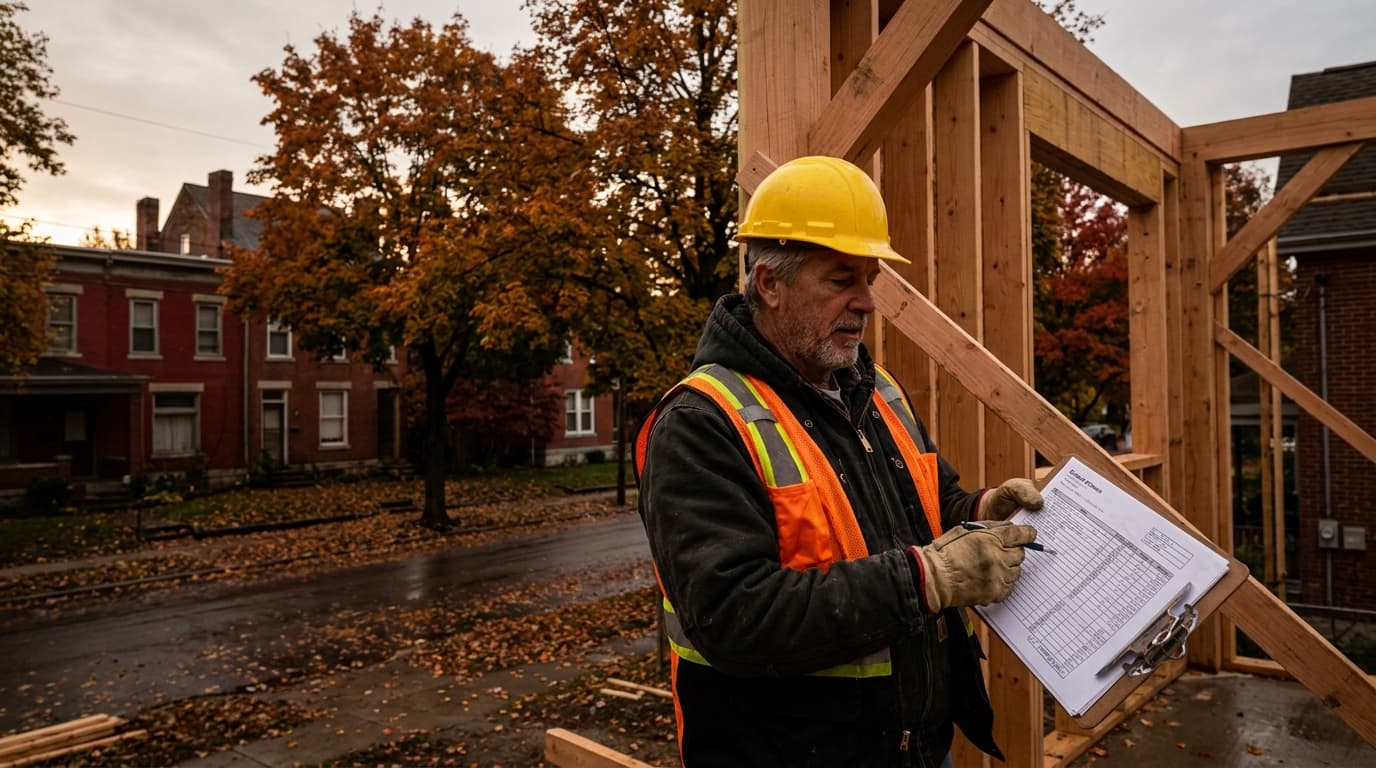
Yes. Construction arbitrage is legal in Ohio. Winning the prime contract, subcontracting the physical work to specialist trades, and keeping the margin between what the client pays you and what you pay the subs is exactly how Ohio's construction market operates. The compliance picture in Ohio is different from most states because there is no single statewide general contractor licence - the rules depend on whether you are doing residential or commercial work, and which city you are operating in.
I have run this model across different markets. Ohio is a large, serious construction environment - Columbus is one of the fastest-growing cities in the Midwest, Cleveland is a busy industrial and residential repair market, and Cincinnati has significant commercial construction activity. The enforcement picture is real, and the 2026 residential registration change means the compliance bar is higher than it was a year ago. Here is what you need to have in place before you take on work.
Is construction arbitrage legal in Ohio - the direct answer
Construction arbitrage is main contracting run lean. You hold the prime contract with the client, subcontract the physical work to vetted trades, and capture the spread. No Ohio statute requires the prime contractor to self-perform any part of the work. The model itself is legal.
What Ohio requires is that the entity holding the prime contract complies with the applicable licensing or registration rules for the work type and location. The Ohio Construction Industry Licensing Board (OCILB), housed within the Ohio Department of Commerce, is the state's main contractor regulator - but it only covers specialty commercial trades and, from January 2026, residential home improvement contractors. Commercial general contracting is regulated at the city and county level.
Ohio has no statewide general contractor licence for commercial work
This is the first thing to understand about Ohio. Unlike Georgia, Arizona, or California, there is no Ohio state general contractor licence for commercial general contracting. The OCILB licenses five specialty commercial trades - electrical, plumbing, HVAC, hydronics, and refrigeration - but there is no Ohio state licence that authorises you to act as a commercial general contractor.
What that means in practice: if you are operating as a prime contractor on commercial jobs in Ohio, the licensing requirement comes from the city or county where the work is located. Columbus has its own system. Cleveland has its own system. Cincinnati has its own requirements. Operating across multiple Ohio cities means understanding and complying with each jurisdiction separately.
This is different from states with a statewide GC licence, where one licence covers you everywhere in the state. In Ohio, commercial general contracting compliance is local.
The 2026 Home Improvement Contractor Registration - HB 614
Ohio's HB 614 - signed into law in 2024 and effective 1 January 2026 - created the first statewide registration requirement for residential contractors. Before this law, there was no statewide residential GC requirement in Ohio at all; only city-level rules applied. That changed from January 2026.
If you perform home improvement work on a 1-, 2-, or 3-family dwelling - remodelling, repair, renovation, or maintenance - you must now register with the OCILB under the Home Improvement Contractor (HIC) registration. The requirements to register:
- Criminal background check - BCI (Ohio Bureau of Criminal Investigation) and FBI fingerprint check
- $25,000 surety bond - must be maintained throughout the registration period
- $500,000 general liability insurance - certificate required at registration and throughout the period
- BWC workers' compensation certificate - proof of current Ohio Bureau of Workers' Compensation coverage
This is a registration system, not a trade exam - there is no qualifying examination for the HIC registration itself. But you must have the bond, insurance, and BWC coverage in place and be clear of criminal history. The OCILB administers the registration.
The $500,000 GL requirement is higher than Ohio's older ORC 4722 floor of $250,000 for home construction service suppliers. If you are registering under HB 614, the $500,000 is the applicable standard.
City-level requirements for commercial contracting
For commercial general contracting, Ohio's three major cities each have their own licensing or registration requirements. You must comply with whichever city or municipality your jobs are located in.
Columbus - The Columbus Department of Building and Zoning Services requires contractors to hold a local general contractor registration. Requirements include a $300 application fee, a $25,000 surety bond, and general liability insurance of $300,000/$500,000. Verify current requirements at columbus.gov before applying - the department updates its requirements periodically.
Cleveland - The Cleveland Building and Housing Department requires a local general contractor licence. Cleveland's system includes a written examination, a $10,000 surety bond, and a minimum $500,000 general liability insurance policy. Contact the Cleveland Building and Housing Department directly to confirm the current exam and application process.
Cincinnati - The City of Cincinnati requires contractors to obtain a local contractor registration certificate. Cincinnati requires an examination, a bond, and proof of insurance. Verify current requirements at the Cincinnati Building Department before applying.
Other Ohio cities and counties have their own systems. If you are operating in smaller Ohio markets outside these three cities - Akron, Dayton, Toledo, Youngstown - check the specific municipal requirements for each jurisdiction before taking on work.
Ohio's OCILB specialty trade licences - what your subs need
The OCILB licenses five specialty commercial trades. Any subcontractor performing this scope of work on a commercial project in Ohio must independently hold the relevant OCILB trade licence:
- Electrical Contractor
- Plumbing Contractor
- HVAC Contractor
- Hydronics Contractor
- Refrigeration Contractor
OCILB trade licences require five years of journeyman experience in the trade (or three years as an Ohio-registered engineer in a related discipline), passing the PSI Business and Law exam plus the trade-specific exam, and a surety bond. These are commercial trade licences - they do not apply to residential work in the same way, where trade licensing varies by city.
Your position as the prime contractor does not cover the scopes your subs are performing. A plumber working under your commercial contract needs their own OCILB plumbing licence. Verify every specialist sub's OCILB licence through the board's public licence search before they start work.
Ohio Bureau of Workers' Compensation - the state monopoly system
Ohio operates a state-monopoly workers' compensation system through the Ohio Bureau of Workers' Compensation (BWC). This is different from most US states. In Ohio, you cannot purchase workers' compensation insurance from a private insurer - all employer workers' comp coverage must go through the BWC.
Every Ohio employer with even one employee must be covered. Sole proprietors working alone with no employees are exempt by default under ORC 4123.01, but the moment any worker is engaged - even temporarily - the BWC obligation arises.
The critical point for construction arbitrage operators: if a subcontractor you engage does not carry valid BWC coverage and one of their workers is injured on your job, you may be treated as a co-employer and held personally liable for that worker's medical costs and lost wages. The BWC enforces this actively.
The practical requirement: demand a current BWC certificate from every subcontractor before they start any work. Make it a non-negotiable step in subcontractor onboarding, the same as proof of general liability insurance. Penalties for failing to carry required BWC coverage include fines of up to $10,000, personal liability for worker injury costs, and potential criminal charges.
What ORC 4722 requires for residential contracts
Ohio Revised Code Chapter 4722 (Home Construction Service Suppliers) applies to contractors performing home construction services where the contract value equals or exceeds $25,000. Above that threshold, a written contract with the property owner is required by law.
A home construction service supplier under ORC 4722 must also maintain general liability insurance of at least $250,000. The Ohio Attorney General can pursue civil penalties of up to $25,000 per violation for breaches of Chapter 4722. In practice, the 2026 HB 614 registration requirements - with their $500,000 GL minimum - set a higher bar that covers the ORC 4722 requirement automatically if you are registered.
What makes it non-compliant
Construction arbitrage is not illegal in Ohio. What creates legal exposure:
- Operating on residential jobs without HB 614 registration - from 1 January 2026, performing home improvement work on 1-3 family dwellings without OCILB registration is a violation of Ohio law
- Operating commercially without the right city licence - working as a GC in Columbus, Cleveland, or Cincinnati without the relevant city registration or licence is non-compliant and can result in stop-work orders and fines
- Using unlicensed specialty subs on commercial jobs - if your electrical, plumbing, or HVAC sub does not hold the relevant OCILB commercial trade licence, the exposure is yours
- No BWC coverage - if your subs are not BWC-compliant and a worker is injured on your job, you face co-employer liability for the claim
- Missing written contracts on jobs over $25,000 - ORC 4722 requires written contracts for residential work above $25,000; operating without them removes consumer protection provisions and exposes you to AG enforcement
- Insurance lapses - if your GL or BWC coverage lapses below the required minimums, your HIC registration or city licence is at risk
Ohio's compliance picture is manageable. The HB 614 registration is a new requirement from 2026 and the state will be enforcing it - do not assume the old position that residential Ohio was unregulated still holds.
The next step
The global legality overview covers the UK, Canada, Australia, Ireland, New Zealand, and other US states in one place. Do you need a contractor licence for construction arbitrage goes deeper on the US state-by-state picture. For the neighbouring state, is construction arbitrage legal in Illinois covers Chicago's class-based city licence system and how Illinois compares. For the full setup sequence from entity registration to first job, how to start a construction arbitrage business covers the complete process.
If you want the full system - licence structure, subcontractor agreements, pricing, and client acquisition - in one place, THE FAMILY SECRET - How Construction Arbitrage Really Works is coming soon.
This is general information, not legal advice. Ohio's HB 614 registration requirements, OCILB trade licence rules, city-level contractor licensing fees and bond amounts, and BWC requirements all change. Verify current requirements directly through the OCILB, your relevant city building department, and the Ohio BWC before you take on work. Consult a qualified Ohio construction attorney for advice specific to your situation.
Last checked: 18 August 2026.
Frequently asked questions
Is construction arbitrage legal in Ohio?+
Yes. Winning the prime contract with a client, subcontracting all physical work to vetted trades, and keeping the spread between the two sides is how Ohio construction has always operated. The compliance requirement depends on the work type and where in the state you operate: residential remodelling and repair requires the new statewide Home Improvement Contractor registration (effective 1 January 2026 under HB 614), while commercial general contracting is licensed at the city and county level. There is no statewide GC licence for commercial work.
Does Ohio have a statewide general contractor licence?+
No. Ohio has no statewide general contractor licence for commercial general contracting. The Ohio Construction Industry Licensing Board (OCILB) licenses five specialty commercial trades - electrical, plumbing, HVAC, hydronics, and refrigeration - but not general contractors. Commercial GC licensing in Ohio is handled at the municipal level, so you need to comply with the specific requirements of each city or county where you work. Columbus, Cleveland, and Cincinnati all have their own contractor registration or licence systems.
What is the HB 614 Home Improvement Contractor Registration?+
Ohio's HB 614, effective 1 January 2026, created the first statewide registration requirement for residential remodelling, repair, or renovation contractors working on 1-, 2-, or 3-family dwellings. To register with the OCILB under HB 614 you need a criminal background check (BCI and FBI), a $25,000 surety bond, $500,000 in general liability insurance, and a valid BWC workers' compensation certificate. Before HB 614, Ohio had no statewide residential GC requirement - only city-level rules applied.
Do subcontractors in Ohio need their own licence?+
Yes, for commercial specialty trade work. Electrical, plumbing, HVAC, hydronics, and refrigeration subcontractors working on commercial projects must independently hold the relevant OCILB trade licence. Your prime contractor position does not extend to your subs. For residential work, subs performing home improvement work must also comply with HB 614's registration requirements if they are contracting directly with the homeowner, or hold their own appropriate trade licence for licensed trade scopes. Verify every subcontractor's licence status through the OCILB licence search before any work begins.
What are Ohio's workers' compensation rules for construction contractors?+
Ohio is a state-monopoly workers' compensation system administered by the Ohio Bureau of Workers' Compensation (BWC). You cannot buy workers' comp from a private insurer in Ohio - all employer coverage must go through the BWC. Every Ohio employer with even one employee must be covered. If a subcontractor you engage does not carry valid BWC coverage, you as the general contractor may be treated as a co-employer and held liable for injuries to their workers. Get a BWC certificate from every sub before they start work.
What does ORC 4722 require for residential construction contracts in Ohio?+
Ohio Revised Code Chapter 4722 (Home Construction Service Suppliers) requires that any contractor performing home construction services costing $25,000 or more must enter into a written contract with the property owner. A home construction service supplier is also required to maintain general liability insurance of not less than $250,000. Violations can attract civil penalties of up to $25,000 per violation, pursued by the Ohio Attorney General. The 2026 HB 614 registration sets a higher $500,000 GL requirement for registered contractors, which supersedes the ORC 4722 floor in practice.
What insurance does a contractor need in Ohio?+
For residential work under HB 614 (effective 2026), the OCILB requires $500,000 in general liability insurance plus a valid BWC workers' comp certificate. For commercial work, insurance requirements vary by city - Columbus requires GL of $300,000/$500,000, Cleveland requires a $500,000 GL minimum. ORC 4722 sets a $250,000 GL floor for home construction service suppliers on contracts over $25,000. Most commercial clients and property managers will require $1 million or more regardless of the legal minimum.

Mohamed El HadriCo-Founder
I'm a co-founder of several construction companies. I built a construction business from a 30-van operation into a lean model with 1,500+ subcontractors in the database - winning the work as the main contractor, subbing it out, and running it as a system from a laptop across multiple countries. I write this site from what actually works.
@mointhemarket · 30k followers on Instagram →Run the model with people who already do
Reading the method is step one. Inside Construction Arbitrage Players you connect with players from around the world who run construction arbitrage every day and make real money from it - share your deals, get answers, and get in the game. Founding-member access is open now.
For the operator life and the inside story, see Contractor Club.
THE EDGE - the listening book on how the money really moves through a contracting business - is out now. Listen free, or see what is inside.
The Family Secret - how construction arbitrage really works - is coming soon.
A construction business built this way is a sellable asset
Systems, subs and margin - that is exactly what buyers pay for. If you own a construction or trade business and the exit is on your mind, list it on ContractorExit, the marketplace for buying and selling trade businesses. The valuation is free, so you find out what it is worth before you decide anything.
Get the Construction Arbitrage playbook
One sharp email a week: real numbers, live deal breakdowns, and the systems that let you run jobs you never visit. No fluff, unsubscribe anytime.