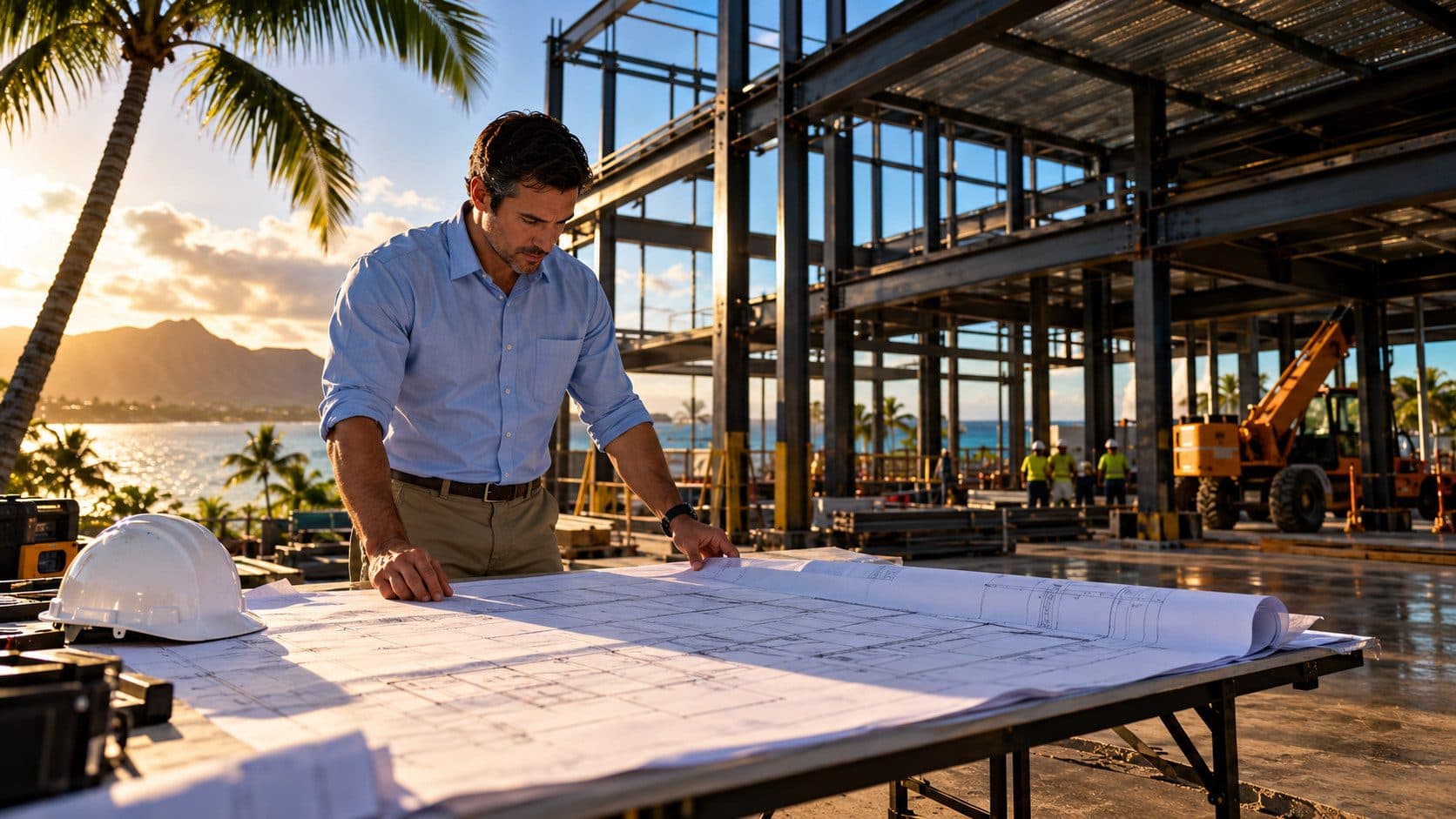
Yes. Construction arbitrage is legal in Hawaii. You hold the prime contract, your licensed subs do the physical work, and you keep the margin in between. That is how every general contractor on the islands already runs. The question is whether your paperwork is in order before you take on a paid job.
Hawaii has one extra step most mainland states do not: you need a General Excise Tax licence before you can even apply for your contractor licence. Miss that order and your application sits in limbo.
Is construction arbitrage legal in Hawaii - what the CLB actually requires
Construction arbitrage means winning work as the prime contractor, subcontracting the physical build to licensed trades, and keeping the spread. Some people call it contractor arbitrage or construction dropservicing - same model, different name. The global legality post explains why the model is legal across every English-speaking market. Subcontracting is standard commercial practice. Hawaii is no different.
The real question in Hawaii is not whether the structure is legal. It is whether you are properly licensed before you start.
Under HRS Chapter 444, a contractor licence is required for any construction work where the combined labour and materials value exceeds $1,500. That exemption disappears entirely wherever a building permit is required - so for most real jobs, the threshold is effectively zero. You cannot split a project into sub-$1,500 pieces to avoid it, and every job that needs a permit requires a licence, full stop.
The Hawaii contractor licence structure
The DCCA Contractors License Board issues licences in three main classes.
Class A - General Engineering: fixed infrastructure and works requiring specialised engineering knowledge. Roads, bridges, grading, pipelines.
Class B - General Building: structures built for shelter involving two or more unrelated trades. This is the standard classification for most residential and commercial work - and the right one for construction arbitrage. A Class B licence also automatically includes a bundle of specialty C-sub-classifications under it.
Class C - Specialty: single-trade contractors. C-13 covers electrical, C-37 plumbing, C-42 roofing, C-31 masonry. Trade subs must hold the correct C classification for their work.
For running the arbitrage model, Class B is your target.
Getting a Class B licence
The process runs through the Contractors License Board at cca.hawaii.gov/pvl/boards/contractor/.
1. Get your GET licence first. Before the CLB will process your application, you need a Hawaii General Excise Tax (GET) licence. Register via Form BB-1 through Hawaii Tax Online. The one-time fee is $20. GET is Hawaii's equivalent of a gross receipts tax - it applies to virtually all business revenue, including construction contracts. The combined rate as of 2026 is 4.5% across all four counties (4% state plus a 0.5% county surcharge). You pass it through to your clients, but it must be registered and remitted. Skip this step and everything downstream stalls.
2. Document four years of supervisory experience. The CLB requires four years of full-time supervisory experience in the Class B classification, within the last ten years, documented with notarised certificates and a project history. A bachelor's degree in engineering, architecture, or construction management can substitute for up to three years of that requirement under HAR 16-77-32.
3. Pass two PSI exams. After the board approves your application, you sit two exams through PSI: the Hawaii Business and Law exam (60 questions, 135 minutes) and the Class B trade exam (100 questions, 240 minutes). Both require a 75% passing score. The Business and Law exam is always required - even applicants from states Hawaii recognises for partial reciprocity must still pass it. Plan the exam schedule carefully; one source says both parts must be passed within the approval window.
4. Post a surety bond. The CLB sets the bond amount per HRS § 444-16.5, with a minimum of $5,000 and a ceiling of $300,000. Most applicants start at $5,000.
5. Carry GL insurance. Hawaii expects general liability coverage at a minimum of $100,000 per person and $300,000 per occurrence for bodily injury, plus $50,000 for property damage. Verify current minimums with the CLB at the time you apply.
6. Licence fees and renewal. Application fees and the biennial licence fee together run somewhere in the range of $500-$600 total - sources disagree on the exact figures, so check the current CLB fee schedule. All Hawaii contractor licences renew by September 30 of every even-numbered year, regardless of when the licence was issued. A current Hawaii tax clearance is required to renew.
Sub-licensing: the rule that catches operators out
Every subcontractor doing work that crosses the $1,500 threshold - or any work requiring a building permit - must independently hold their own valid CLB licence in the correct classification. Your Class B prime licence covers you. It does not cover your subs.
This matters more in Hawaii than many mainland states because the island sub market is smaller. There are fewer contractors to choose from, and a licensing gap takes longer to fill. Verify your subs' CLB licence status before any job starts, not after something goes wrong. The CLB licence lookup is at cca.hawaii.gov/pvl.
Trade subs carry additional layers:
- Electrical: must be separately licensed under HRS Chapter 448E through the DCCA Board of Electricians, independent of the CLB classification.
- Plumbing: licensed through a separate DCCA board.
- HVAC/mechanical: licensed separately.
Your sub can hold both a CLB C-class licence and the relevant trade licence - but both are needed for electrical and plumbing work.
Workers' compensation in Hawaii
Hawaii requires workers' compensation cover from the moment you hire a single worker - HRS Chapter 386. There is no minimum headcount, no grace period, no construction exemption.
The Disability Compensation Division administers the scheme. Penalties for failing to cover an employee run at a minimum of $500 per day or $100 per employee per day the violation continues, whichever is greater. The state can also seek an injunction stopping you from operating.
One practical note for the arbitrage model: Hawaii has a dual IC test. For unemployment insurance purposes, the state uses the three-part ABC test under HRS § 383-6. For workers' compensation, courts apply a separate right-to-control analysis based on 20 common-law factors in HAR § 12-5-2. A sub who passes the unemployment ABC test may still be classified as your employee for WC purposes if the facts of the relationship point that way. The safest path is to use subs who are independently licensed, have their own WC cover for their workers, and operate as independent businesses.
Verify your subs' insurance before they start. Get certificates naming you as an additional insured, and request fresh ones at renewal.
The GET on jobs - what it means for the spread
Hawaii's General Excise Tax is different from the mainland sales taxes you might be used to. It is a gross receipts tax on the business - on what you collect, not what you sell. At 4.5%, it applies to your invoices.
In practice, most Hawaii contractors pass the GET through to clients as a line item on the invoice. That is permitted but not automatic - you need to contract for it explicitly. If you absorb it, it comes out of your margin. A $50,000 job carries $2,250 in GET at 4.5%. Build it into your pricing from day one.
The GET rate also applies to your subs' invoices to you, and you can generally claim an exclusion or deduction for amounts paid to subs who separately have their own GET licences. Keep that documentation clean.
The Hawaii spread: why the numbers work differently here
Hawaii has some of the highest labour costs in the United States. Trades charge more on the islands than they do on the mainland - transportation costs, cost of living, and a smaller supply of available contractors all push rates up. The same job that earns a $5,000 spread in Atlanta might carry $8,000-$12,000 on Oahu.
The flip side is that the sub pool is thinner. You have fewer licensed subs to choose from, and the best ones stay busy. Building a reliable sub network takes longer here than in a large mainland metro. That network - once built - is a genuine competitive moat. Nobody coming in from the mainland with a laptop and a list of HomeAdvisor subs is going to replace years of relationships on the ground.
The model works. It is just tighter to operate. That means stronger vetting before you bring a sub onto a job, and more care in pricing to protect the margin. See how to find good subcontractors for the filter process I use.
What this means for construction arbitrage in Hawaii
The model is legal. The compliance picture is more involved than some mainland states - a CLB Class B licence, GET registration first, four years of documented experience, two PSI exams, bond, insurance, and independently licensed subs. But every general contractor in Hawaii already operates this way.
If you are running construction arbitrage or what some call construction dropservicing - winning the prime contract and subbing the labour - you are doing what the state's licensing system is designed for. Class B is the general building contractor licence. The CLB expects licensees to use licensed subs. That is the system.
Get the GET licence first. Then apply to the CLB. Then find subs who independently hold their own DCCA credentials. Do not skip the WC verification on your subs.
Last checked: 19 October 2026.
Frequently asked questions
Is construction arbitrage legal in Hawaii?+
Yes. Winning the prime contract, subcontracting the physical work to licensed trades, and keeping the spread is legal in Hawaii. That is how general contracting works. What the law requires is a valid contractor licence from the DCCA Contractors License Board (CLB) under HRS Chapter 444 and a Hawaii General Excise Tax (GET) licence - which must be obtained first. Every sub you use must independently hold their own CLB licence in the right classification.
What licence do you need for construction arbitrage in Hawaii?+
You need a Class B General Building Contractor licence from the DCCA Contractors License Board. Class B covers structures built for shelter involving two or more unrelated trades - which is exactly what construction arbitrage covers. Getting there requires four years of documented supervisory experience (within the last ten years), passing two PSI exams (Business and Law plus the Class B trade exam) both at 75%, a $5,000 surety bond, GL insurance, and a Hawaii GET licence obtained before you apply for the contractor licence.
What is the Hawaii GET licence and why do contractors need it?+
The Hawaii General Excise Tax (GET) is a gross receipts tax that applies to nearly all business activity in Hawaii, including construction. The current combined rate is 4.5% (4% state plus a 0.5% county surcharge in all four counties as of 2026). You must register for a GET licence via Form BB-1 through Hawaii Tax Online before the Contractors License Board will issue your contractor licence. The one-time registration fee is $20. GET is generally passed to your client - but it must be registered and remitted, not ignored.
Does a subcontractor in Hawaii need their own licence?+
Yes. Every subcontractor performing work that meets the $1,500 labour-and-materials threshold (or any work requiring a building permit, regardless of value) must independently hold their own valid CLB licence in the appropriate classification. Your Class B prime licence does not extend to your subs. Trade subs doing electrical work must also hold a separate licence under HRS Chapter 448E through the DCCA Board of Electricians. Plumbing and HVAC subs hold their own separate DCCA licences. Verify before they set foot on site.
What is the Hawaii contractor licence threshold?+
Under HRS Chapter 444, a contractor licence is required for any construction work where the combined labour and materials value exceeds $1,500. That exemption was raised from $1,000 by Act 283 in 2019. The exemption is void in its entirety wherever a building permit is required - so for most real jobs, the threshold is effectively zero. You cannot split a larger project into sub-$1,500 pieces to avoid the licence requirement.
What workers' compensation rules apply in Hawaii construction?+
Hawaii requires workers' compensation cover from the moment you employ a single worker - HRS Chapter 386. There is no minimum headcount and no grace period after your first hire. The Disability Compensation Division administers it. Penalties for non-compliance run from $500 per day or $100 per employee per day, whichever is greater. Cover is obtained through private-market carriers. The one-employee trigger applies to all employers, including construction.
What are the penalties for working without a Hawaii contractor licence?+
Under HRS 444-23, an unlicensed person performing work that requires a licence faces a fine of $2,500 or forty percent of the total contract price - whichever is greater - for a first offence. General violations of Chapter 444 carry fines of up to $5,000 per violation. The DCCA can also seek injunctive relief. Unlicensed contracts are unenforceable, meaning you cannot sue to collect unpaid invoices on work you performed without a valid licence.
Is construction arbitrage the same as construction dropservicing in Hawaii?+
Yes - same model, different names. Construction dropservicing and contractor arbitrage both describe holding the prime contract, subcontracting the physical work to licensed trades, and keeping the spread. The DCCA contractor licence and GET licence requirements apply regardless of which label you use.

Mohamed El HadriCo-Founder
I'm a co-founder of several construction companies. I built a construction business from a 30-van operation into a lean model with 1,500+ subcontractors in the database - winning the work as the main contractor, subbing it out, and running it as a system from a laptop across multiple countries. I write this site from what actually works.
@mointhemarket · 30k followers on Instagram →Run the model with people who already do
Reading the method is step one. Inside Construction Arbitrage Players you connect with players from around the world who run construction arbitrage every day and make real money from it - share your deals, get answers, and get in the game. Founding-member access is open now.
For the operator life and the inside story, see Contractor Club.
THE EDGE - the listening book on how the money really moves through a contracting business - is out now. Listen free, or see what is inside.
The Family Secret - how construction arbitrage really works - is coming soon.
A construction business built this way is a sellable asset
Systems, subs and margin - that is exactly what buyers pay for. If you own a construction or trade business and the exit is on your mind, list it on ContractorExit, the marketplace for buying and selling trade businesses. The valuation is free, so you find out what it is worth before you decide anything.
Get the Construction Arbitrage playbook
One sharp email a week: real numbers, live deal breakdowns, and the systems that let you run jobs you never visit. No fluff, unsubscribe anytime.