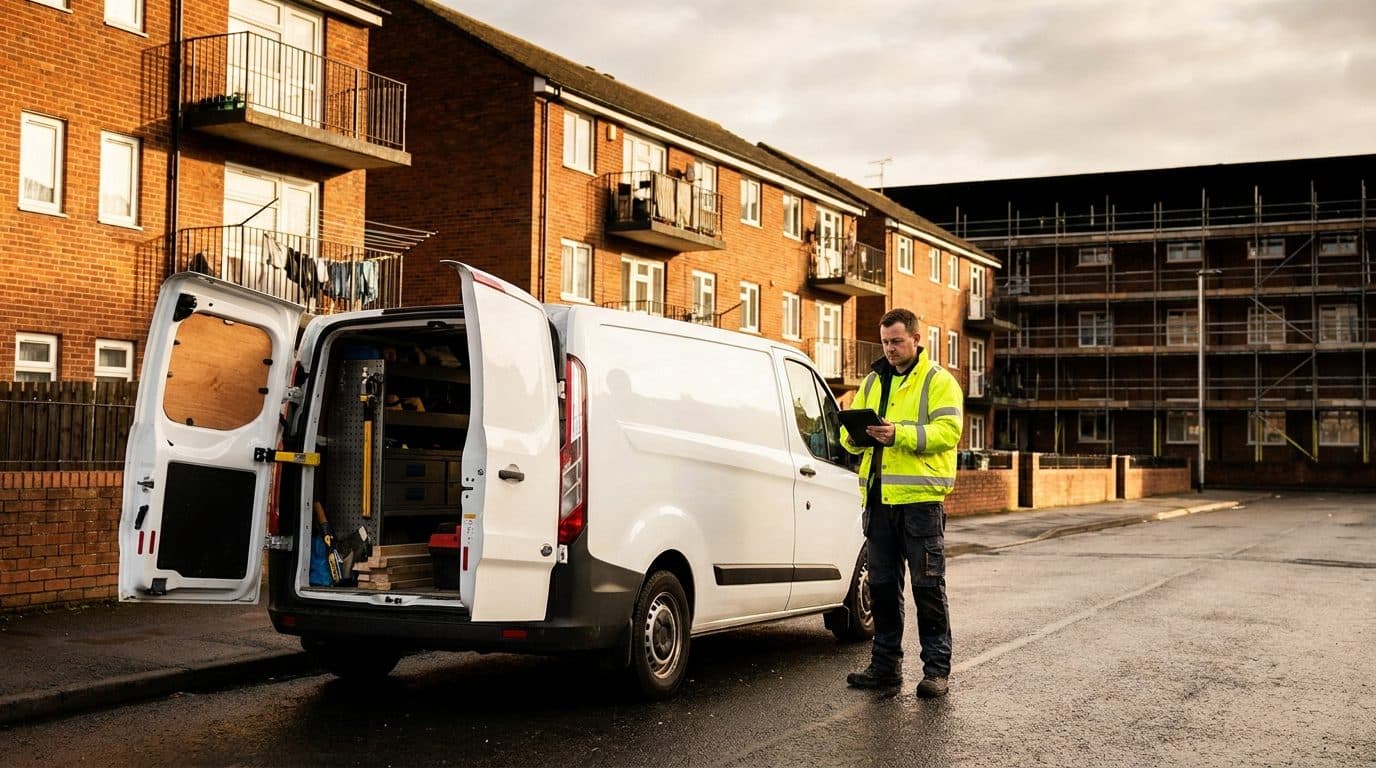
The efficient way to register on council procurement portals is to stop registering with councils one at a time. Most UK councils and housing associations run their buying through a handful of shared e-procurement platforms, so one account on each platform covers every buyer using it. Eight registrations, done once, reach hundreds of organisations.
I run a subcontracting model - win the work, sub the delivery, keep the spread - and public-sector demand is some of the steadiest demand there is: repairs, maintenance, voids, compliance work, year in, year out. The barrier that stops most firms is not capability. It is that nobody tells you where the doors are, so operators either register nowhere or burn a week registering everywhere. Both are wrong. Here is the leverage table.
How to register on council procurement portals: the leverage table
We track 557 UK work-winning gates - places where construction work is actually handed out - and mapped where each one takes its supplier registrations. These eight are the master registrations: single signups that cover many buyers at once. All of them are free for suppliers.
1. Find a Tender - the one that is now compulsory. Since 24 February 2025, Find a Tender fronts the government's Central Digital Platform under the Procurement Act 2023. Register once, get your PPON (Public Procurement Organisation Number), and every regulated public buyer in the UK can pull your company details through a share code. If you only make one registration from this list, make this one - the section below explains what changed.
2. Contracts Finder - the small-jobs radar. The legacy home of below-threshold notices, being folded into Find a Tender but still publishing - and the deadline for authorities to stop posting below-threshold notices here was pushed back to 1 May 2027, so it stays worth watching. Free alerts on smaller contracts, exactly the size a first-time public-sector supplier can credibly win. I broke the two portals down side by side in which portal to use in 2026.
3. ProContract - the biggest single lever in local government. The Proactis-run portal family is the most widely used in UK councils and social housing. One registration covers every buyer tendering through it: Sanctuary, Guinness, Orbit, most London boroughs, and hundreds more. Set your work categories once and the opportunities email you.
4. Housing Procurement Portal - rides on the same account. A shared hub where several large housing associations - Orbit and Home Group among them - run their tendering on ProContract's rails. Your ProContract registration covers it; you just need to know it exists to watch it.
5. Delta eSourcing - the housing association heavyweight. One central supplier signup covering Notting Hill Genesis, Metropolitan Thames Valley, A2Dominion and hundreds of other buyers. If your pipeline is landlord repairs and maintenance, this is the second registration to make after Find a Tender.
6. EU Supply CTM - the northern block. One registration covers the buyers running on the CTM platform, including YORtender's 27 Yorkshire authorities and Yorkshire Housing. If you operate anywhere in the north, this one signup is a region-wide door.
7. myTenders - the aggregating layer. Millstream's platform (the Sell2 family) hosts notices for a long tail of public buyers that do not run their own portal. Free supplier registration; ignore the paid tiers until the free alerts have proven the pipeline.
8. Local Supply Chain - the DPS host. LSC hosts dynamic purchasing systems for Sanctuary and other large landlords - rolling lists you can apply to join at any time rather than waiting for a tender window. That standing-list mechanic is the friendliest format in public procurement for a smaller firm.
That is the whole job: eight forms, one afternoon, hundreds of buyers watching your inbox instead of you watching theirs.
The maths: why eight signups beat thirty portals
Of the 557 UK work sources in our directory, 141 route their supplier intake through a shared e-procurement platform rather than a form of their own - and the spread is heavily concentrated. As of July 2026, ProContract carries 16 of our tracked buyers, Delta 12, EU Supply CTM 5, with Atamis, Jaggaer and the rest carrying a few each. Every one of those is covered by the table above or by a single extra account when a specific buyer you want uses one of the smaller platforms.
The honest exception is In-tend. It is the single most common platform in our data - 78 of the 557 tracked sources run In-tend portals - but In-tend instances are set up per buyer, so each one is its own registration. There is no master signup. That is exactly why the shared platforms above are worth doing first: they are the genuine one-to-many doors, and In-tend is the long tail you work through afterwards, buyer by buyer, starting with the landlords and councils in your patch.
Two numbers worth holding onto from the wider dataset: 253 of the 557 gates are open signup - no invitation, no waiting for a tender window - and the master registrations above are how you cover the densest slice of them in one sitting.
What a council procurement system actually is
Half the people searching for a "council procurement system" or a "council purchasing system" are not looking for a portal login. They are trying to understand the machine: how a council decides to spend money on building work, and where each kind of spend surfaces. Worth ten minutes, because it tells you which door is worth your effort.
The system is two layers stacked on each other. The rules layer is the Procurement Act 2023, which governs how contracting authorities in England, Wales and Northern Ireland buy. The software layer is the portal the individual council runs its process through - ProContract, In-tend, Delta, whichever - plus Find a Tender, where the regulated notices are published centrally. When somebody says "the council's purchasing system", they usually mean the software. What decides whether you ever see the opportunity is the rules.
Under those rules, spend splits by value, and the numbers matter more to a builder than to almost anyone else:
- Under £30,000 including VAT. The council can buy directly. No notice, no tender, often a call to somebody already on an approved list or a framework. A huge share of reactive repairs and small works lives here, and it is invisible to anyone waiting for a tender alert.
- From £30,000 up to the regulated threshold. If the council advertises openly rather than to a closed group of pre-selected suppliers, it must publish a below-threshold tender notice first. Central government has the same duty from £12,000. This band is the realistic first-win territory.
- At or above the threshold for the contract type. The full regulated regime applies. From 1 January 2026 those thresholds are £207,720 including VAT for goods and services at a council or housing association, and £5,193,000 for works contracts. They are reset every two years and this round they came down slightly, which pulls marginally more spend into the regime.
Read that works figure again, because it is the single most misunderstood number in public-sector construction. Almost no council building contract is worth £5.19m. Which means almost all council building work is technically below threshold - bought through frameworks, dynamic markets, approved lists and direct award, not through the open mega-tender people picture when they imagine "winning a council contract".
That is also why the standing arrangements are where the money is. A framework is a pre-competed panel: the council runs one procurement, appoints a group of suppliers, then calls off individual jobs against it for years without going back to the market. A dynamic market - the Procurement Act's replacement for the old dynamic purchasing system, with legacy DPS arrangements running down to 27 October 2028 - works similarly but stays open, so new suppliers can join at any point rather than waiting for a renewal window. An approved or select list is the same idea at a smaller, more local scale. Get onto one of these and the work comes as call-offs and orders, not as tenders. I have broken that route down properly in how to get on a council approved contractor list.
So the honest answer to "how does the council purchasing system work" is: the portal shows you the front door, the Act decides which spend has to walk through it, and most of the actual construction money moves through standing arrangements behind it. Register for the portals to hear the windows open. Aim at the frameworks, dynamic markets and lists, because that is what pays repeatedly.
Find a Tender, the PPON and what changed
The Procurement Act 2023 went live on 24 February 2025 and rebuilt the plumbing of UK public buying around one system. What it means at your end, verified against the government's own guidance:
- One supplier record. You register once on the Central Digital Platform through Find a Tender, enter your core company information, and receive a PPON. From then on you hand any contracting authority a share code instead of re-typing your details into their forms. The days of maintaining fifteen versions of the same company profile are ending.
- Housing associations are inside the regime. Registered providers of social housing count as contracting authorities, so the same platform mechanics reach landlord work, not just council work.
- The small stuff is published too. Councils and other sub-central buyers advertising contracts over £30,000 publish them through the platform, and award details as well. That below-threshold layer is where first wins actually live - jobs too small for the big players to chase.
- The publication route moved again in 2026. From 1 April 2026 the Central Digital Platform became the primary publication service for notices under the Act, and since then a supplier awarded a below-threshold contract has to be registered and give the buyer its identifier. The one deadline that slipped is below-threshold notices leaving Contracts Finder, now 1 May 2027 - the full timeline is here.
- Thresholds moved in January 2026. The financial thresholds that decide which contracts get the full regime were updated from 1 January 2026, as they are every two years. The practical takeaway does not change: registration is free, the PPON takes minutes, and without it you are invisible to the fastest-growing slice of published work.
One caution from the other side of the table: platform registration is machinery, not marketing. Nobody reads your ProContract profile for pleasure. The registrations put opportunities in your inbox; what wins them is everything else.
What a registration does not do
I have watched operators make all eight registrations, sit back, and conclude six months later that "council work is a myth". The registrations are necessary, not sufficient. Three things decide whether they produce money:
Your alert setup. Every platform lets you pick work categories and regions. Set them too narrow and you see nothing; too wide and you learn to ignore the emails, which is worse. Pick the two or three trades you can actually deliver at margin and the geography your subs genuinely cover - the same discipline as knowing where your clients come from in any other channel.
The paperwork stack. When an opportunity lands, the selection questionnaire asks for the same things every time: insurance at specified levels, accounts or financial standing, references, and increasingly an SSIP-level health and safety badge. Across our requirements data, insurance evidence is the single most demanded item in UK procurement - asked for more often than any accreditation. Get the contracts, insurance and legal stack right once and every subsequent bid reuses it; scramble for it per-bid and you will miss every deadline.
Patience with the windows. Much council and housing association work moves through DPS arrangements and approved lists that open on their own schedule - I have broken down how those lists actually work, council by council, in its own post. The portal account is how you hear the window open. It can take months. This channel is a slow-burn lane you set up beside faster ones, which is exactly how I frame it in starting a property maintenance business - the public-sector pipeline matures while the private work pays this month's bills.
And remember the buyers are not only councils - or even portals. The in-house council workforces themselves buy in trades when demand peaks, mostly without a tender notice in sight; DLO subcontracting is that route, and it pairs naturally with the registrations above. The insurance repair machine runs on the same logic - a small number of chokepoints controlling a large volume of dispatched work - and the same operator playbook applies: find the chokepoint, register once, meet the vetting bar, let volume come to you.
Leverage in this game is not working harder. It is finding the doors where one signup covers a hundred buyers, and walking through all of them in one afternoon.
The next step
The table above is the map, and it will get you registered. What it cannot give you is sequence and speed: which registrations members are actually winning through this quarter, the master company sheet that fills every selection questionnaire from one document, and the sprint that gets all of this done in a fortnight instead of drifting for a season. That is what the community is for - operators running the same model on the same portals, comparing notes in the open.
Last checked: 19 August 2026.
Frequently asked questions
How do you register on council procurement portals?+
Mostly, you do not register with the council at all - you register with the e-procurement platform the council runs its tenders through. A handful of platforms host most UK council and housing association buying: ProContract, Delta eSourcing, EU Supply CTM and the government's own Find a Tender service. One supplier account on each covers every buyer using that platform, so eight registrations reach hundreds of organisations.
What is ProContract and which buyers use it?+
ProContract, run by Proactis and hosted at procontract.due-north.com, is the most widely used tender portal family in UK local government and social housing. One free supplier registration covers every buyer running opportunities through it - among them Sanctuary, Guinness, Orbit and most London boroughs, plus the shared Housing Procurement Portal hub that several large housing associations tender through.
Is it free to register on council procurement portals?+
Yes. Supplier registration on every platform named in this post - Find a Tender, Contracts Finder, ProContract, Delta eSourcing, EU Supply CTM, myTenders, Local Supply Chain - is free. Several of them sell paid alert or intelligence add-ons; you do not need any of them on day one. Where money genuinely enters public-sector work is later, in accreditations and insurance, not in portal accounts.
What is a PPON and do I need one?+
A PPON is a Public Procurement Organisation Number, issued when an organisation registers on the government's Central Digital Platform - the enhanced Find a Tender service that went live on 24 February 2025 under the Procurement Act 2023. If you want to bid for regulated UK public contracts, you register once, get your PPON, and use share codes to pass your company details to any contracting authority instead of re-typing them for every bid.
How does the council purchasing system work?+
It is two layers. The rules layer is the Procurement Act 2023, which decides what a council must advertise; the software layer is the e-procurement portal the council runs - ProContract, In-tend, Delta and so on - plus Find a Tender for regulated notices. By value: under £30,000 including VAT a council can buy directly, from £30,000 it must publish a below-threshold tender notice if it advertises openly, and the full regulated regime starts at £207,720 for goods and services or £5,193,000 for works from 1 January 2026. Because almost no council building contract reaches the works threshold, most construction spend moves through frameworks, dynamic markets and approved lists rather than open tenders.
What is a council procurement system?+
A council procurement system is the combination of the legal rules a council must follow (the Procurement Act 2023) and the e-procurement software it publishes and awards work through - ProContract, In-tend, Delta eSourcing and the government's Find a Tender service being the ones that cover most of UK local government. Register as a supplier on the handful of software platforms rather than chasing each council individually, and the system's own notices and alerts do the finding for you.
What is the difference between a framework and a dynamic market?+
A framework is a pre-competed panel: the council runs one procurement, appoints a group of suppliers, then calls off individual jobs against it for the life of the framework without returning to the market. A dynamic market - the Procurement Act 2023 replacement for the dynamic purchasing system, with legacy DPS arrangements running down to 27 October 2028 - does the same job but stays open, so a supplier can apply to join at any time instead of waiting for a renewal window. For a repairs or maintenance firm the dynamic market is usually the easier door because there is no closed window to miss.
Can a small subcontractor realistically win council work?+
Yes, but rarely by bidding for a big contract on day one. The realistic entries are small below-threshold jobs advertised on the portals, approved-list and DPS openings that let small firms onto call-off rosters, and subcontracting to the main contractors and direct labour organisations that already hold the contracts. The registrations cost nothing and the alerts tell you when each of those doors opens.
Mohamed El HadriCo-Founder
I'm a co-founder of several construction companies. I built a construction business from a 30-van operation into a lean model with 1,500+ subcontractors in the database - winning the work as the main contractor, subbing it out, and running it as a system from a laptop across multiple countries. I write this site from what actually works.
@mointhemarket · 30k followers on Instagram →Run the model with people who already do
Reading the method is step one. Inside Construction Arbitrage Players you connect with players from around the world who run construction arbitrage every day and make real money from it - share your deals, get answers, and get in the game. Founding-member access is open now.
For the operator life and the inside story, see Contractor Club.
THE EDGE - the listening book on how the money really moves through a contracting business - is out now. Listen free, or see what is inside.
The Family Secret - how construction arbitrage really works - is coming soon.
A construction business built this way is a sellable asset
Systems, subs and margin - that is exactly what buyers pay for. If you own a construction or trade business and the exit is on your mind, list it on ContractorExit, the marketplace for buying and selling trade businesses. The valuation is free, so you find out what it is worth before you decide anything.
Get the Construction Arbitrage playbook
One sharp email a week: real numbers, live deal breakdowns, and the systems that let you run jobs you never visit. No fluff, unsubscribe anytime.