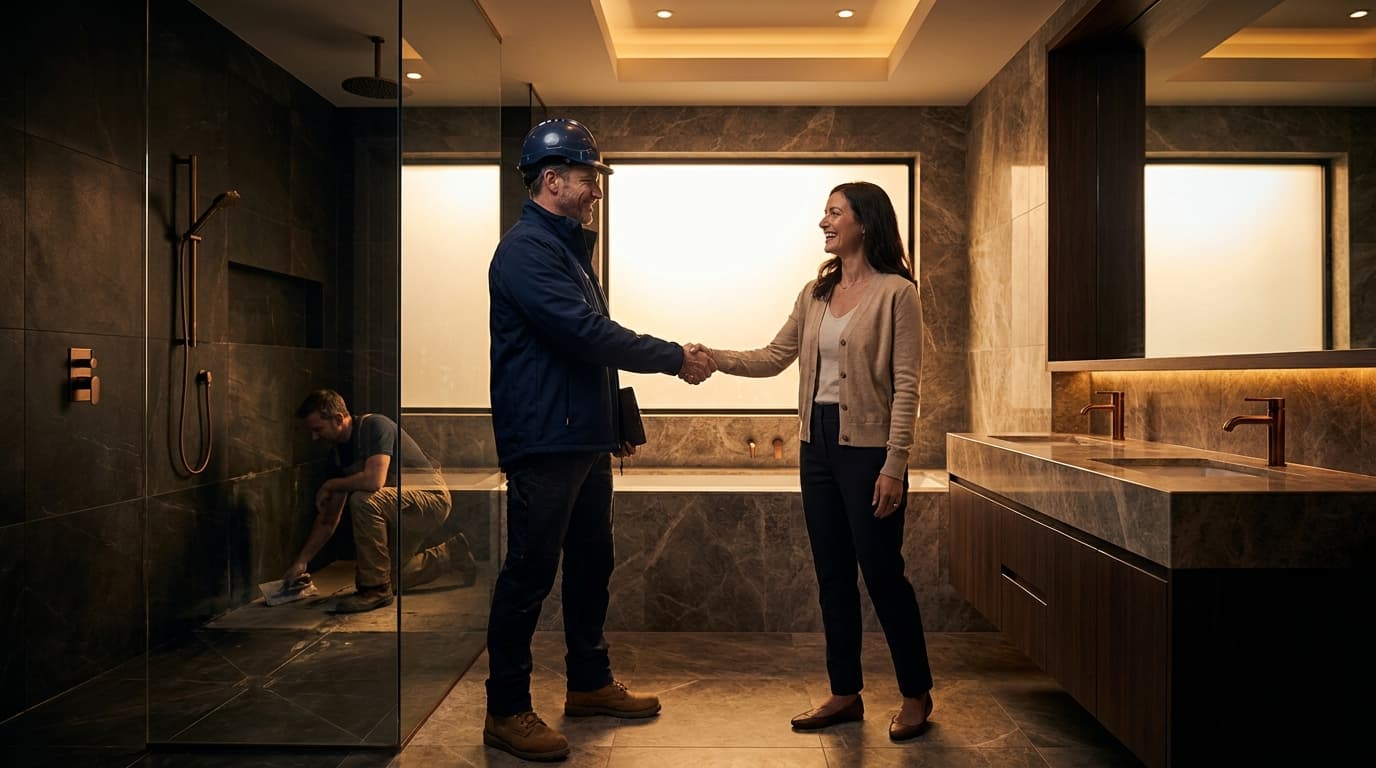
Most clients do not care whether you subcontract the work. What they care about is that the job gets done properly, on time, and that there is someone to call if it does not. In construction arbitrage, you are that someone - the accountability sits with you regardless of who swings the hammer.
Why most clients do not care if you subcontract
Clients hire a contractor to solve a problem and be rid of it. They are not hiring a labour force - they are hiring accountability. When a client books you to refit a kitchen, they want the kitchen refitted. Whether your plumber or mine does the rough-in is not their concern, as long as the taps work and the drain lands in the right place.
This is not a theory. Every large housebuilder operates this way. Tier-one main contractors on major infrastructure projects sub out the majority of physical work to specialist packages. General contractors in the US, UK, Canada, Australia - all of them. The model pre-dates the term "construction arbitrage" by decades. Clients have been on the receiving end of this arrangement for as long as construction contracts have existed, whether they knew it or not.
The real concerns - and how to deal with them
The research on client attitudes is consistent. Homeowners do not object to subcontracting in principle. What makes them uneasy is a specific set of practical worries.
Accountability gap. If the sub does bad work and you disappear, who fixes it? The answer is straightforward: your name is on the prime contract and the liability sits with you. Make this explicit when you sign the client: "I coordinate the trades - if anything is wrong, you call me." That one sentence handles the objection before it becomes one.
Unknown people on site. Some residential clients are uncomfortable with workers they have never met walking through their home. Manage it by keeping the client in the loop. A short message the evening before - "the tiling team will be with you from 8 tomorrow" - costs nothing and removes almost all of the friction.
Communication gaps. The worst thing a sub can say to a client is "you'll have to ask the contractor, I'm just a sub." It makes you look absent and the client feel sidelined. The fix: brief your subs before they start. They answer trade-specific questions, refer everything else to you. That is your site, your client, your job.
Unverified trades. Some clients have been burned before - contractors who presented as established operations but used uninsured or unqualified labour. It is a legitimate concern. The answer is to vet your subcontractors properly before anyone walks through the door. Verify insurance, licences, and references. When a client asks whether your subs are insured, you say yes - because they are.
Residential clients vs commercial clients
The level of scrutiny differs significantly by client type.
Residential clients - homeowners hiring you for repairs, extensions, renovations - rarely have strong views on subcontracting arrangements. Their contract is with you. The job either passes their inspection or it does not. Your relationship, your communication, and the quality of the finished work are what they judge.
Commercial clients - businesses, landlords with portfolios, facilities managers, public-sector bodies - tend to have tighter contracts. It is common for a commercial prime contract to include a clause requiring written consent before subcontracting portions of the work. Some cap the percentage of the contract value you can pass to subs. I covered the legal side of this in the post on whether you have to tell the client you're subcontracting. The short version: read every contract before you sign it, not after.
When the client tries to go around you
The scenario every operator needs to prepare for: a client corners your sub on site and tries to have a direct conversation about the job, the pricing, or - the real one - whether they can hire the sub directly next time.
This is not a disclosure problem. It is a process failure.
- Manage all project communication yourself. The client messages you, you relay to the sub.
- Brief subs before the job starts. They do not discuss pricing, future work, or their own business with the client.
- Your prime contract with the client and your subcontract agreement should both reflect this arrangement. The contracts you need are not complicated, but they have to be in place before the job starts.
Lock the process and the problem does not arise. Leave the process open and you will lose a sub to a client eventually. It happens to everyone who does not fix it early.
What I say when clients ask directly
I have been asked whether I do the work myself. The answer is honest and short: "I manage the project and coordinate the trades - the specialists I use are people I've worked with for years. My name is on the contract, so if anything isn't right, it comes back to me."
That satisfies almost every residential client. The few it does not satisfy were going to be difficult regardless. The question is almost never a deal-breaker - it is curiosity. Handle it professionally and move on.
Subcontracting is not a secret you are keeping. It is how the industry works. Your value is the coordination, the client relationship, and the accountability - not the hours on site.
The actual risk is not clients caring - it is quality
Clients discovering you use subcontractors almost never loses you the job. What loses you the job - and your reputation - is a sub who messes up the work. That is where your attention belongs.
The client does not care who holds the tile cutter. They care whether the tiles are straight. Build the system around quality and accountability and the "who actually does the work" question becomes trivial.
For the full picture on how the model works from end to end, the pillar post covers what construction arbitrage is and why the spread works.
Frequently asked questions
Do most residential clients care if the work is subcontracted?+
No. Most residential clients care about quality, completion, and having someone accountable. Their contract is with you, and you carry the liability. Subcontracting is how the construction industry has always worked.
What do clients actually worry about when subcontractors are involved?+
The real concerns are quality, accountability, and communication - not the fact of subcontracting itself. Clients worry about who is responsible if something goes wrong, whether the people on site are qualified, and whether they can get straight answers.
What if a client asks if I'm using subcontractors?+
Answer honestly. Subcontracting is normal practice. Say that you coordinate specialist trades and that your name is on the contract - meaning any issue comes back to you. Never deny it.
Do commercial clients care more about subcontracting than residential clients?+
Generally yes. Commercial and public-sector clients often include explicit subcontracting clauses requiring consent or capping the percentage you can sub out. Read every contract before signing. Residential clients rarely have these clauses.
Can I lose a job because I use subcontractors?+
It is very unlikely on private residential work. On commercial or public-sector contracts, failing to comply with a subcontracting clause can cost you the contract. On residential work, the bigger risk is a client going around you to negotiate directly with the sub - which is why you control all site communication.

Rob LazFounder
I'm a founder of several construction companies and of Contractor Club. I run a seven-figure construction business remotely - I haven't touched a tool in two years - and I teach others how to do the same.
@roblaz__ · 20k followers on Instagram →Run the model with people who already do
Reading the method is step one. Inside Construction Arbitrage Players you connect with players from around the world who run construction arbitrage every day and make real money from it - share your deals, get answers, and get in the game. Founding-member access is open now.
For the operator life and the inside story, see Contractor Club.
THE EDGE - the listening book on how the money really moves through a contracting business - is out now. Listen free, or see what is inside.
The Family Secret - how construction arbitrage really works - is coming soon.
A construction business built this way is a sellable asset
Systems, subs and margin - that is exactly what buyers pay for. If you own a construction or trade business and the exit is on your mind, list it on ContractorExit, the marketplace for buying and selling trade businesses. The valuation is free, so you find out what it is worth before you decide anything.
Get the Construction Arbitrage playbook
One sharp email a week: real numbers, live deal breakdowns, and the systems that let you run jobs you never visit. No fluff, unsubscribe anytime.