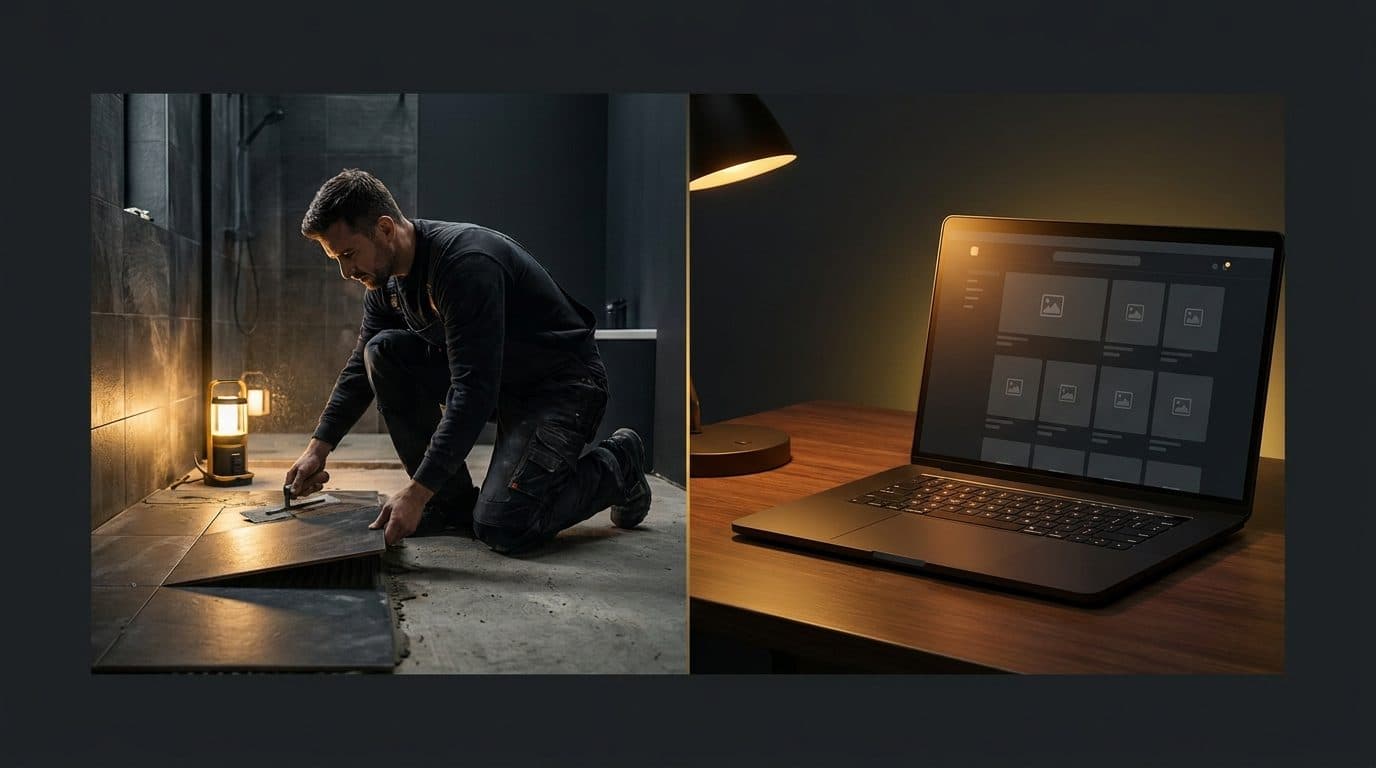
Construction arbitrage and dropshipping both let you earn without doing physical work yourself. The difference is structural: construction arbitrage is a local service business where competitors have to win the same clients in the same market as you. Dropshipping is a global product model where anyone can undercut your price from the other side of the world.
That single difference cascades into everything - margins, competition, startup costs, and whether you are building a defensible business or fighting an endless price war.
How construction arbitrage and dropshipping actually work
Construction arbitrage is the business layer on top of the trades. You win contracts from clients as the main contractor, subcontract the physical work to vetted specialists, and keep the spread between what the client pays and what the sub charges. No tools from you. But it is a service business anchored to a real place and a real client.
Dropshipping is an ecommerce model where you list products in an online store, a customer buys, and a third-party supplier ships directly to them. You never hold inventory. The product can ship from any country, and any competitor can list the identical product from the same supplier within hours of you doing it.
Both models put you in the middle taking a margin. The market dynamics are entirely different.
Side by side
| Construction arbitrage | Dropshipping | |
|---|---|---|
| What you sell | A construction service (local) | Physical products (global) |
| Competition | Local contractors in your area | Sellers globally, often from the same supplier |
| Gross margins | 20-35% on small works | 10-30%, average around 15-20% net |
| Startup costs | Business registration, insurance, licensing | Store platform + initial ad spend |
| Deal structure | A few high-value transactions per month | Many low-value transactions at volume |
| Can a competitor copy you overnight? | No - local relationships take time to build | Yes - same product, same supplier, same ad platform |
The competition reality
This is the structural gap most people miss when they compare these two models.
When you win a renovation contract in your local market, no seller in another country can bid on it. Construction is physical. The work has to happen at a specific property, on a specific date, by a person who can show up. Your real competition is the contractor who did not return the call, who quoted three weeks late, or whose previous client warned a mutual contact. That is a winnable game - and it rewards consistency and reliability more than it rewards being cheapest.
Dropshipping puts you in a global price war from day one. A competitor can find your top-selling product, source it from the same supplier at the same price, and launch ads to the same audience this week. Platform algorithm changes on Shopify, Meta, or Amazon can wipe your traffic without warning. Industry statistics consistently show around 90% of new dropshipping stores do not reach what most people would define as success in year one. In a 2025 survey of store owners, 52% cited low margins as a major operational problem and 64% named shipping delays as their biggest pain point.
That is not a reason to never try dropshipping. It is a structural fact about the market you are entering.
The margins in real numbers
Construction arbitrage gross margins of 20-35% on small works and renovations require discipline to protect. A $15,000 renovation might cost $10,000-$11,000 to deliver once you account for sub labour, materials if you are handling supply, your insurance allocation, and a contingency for surprises. That leaves $4,000-$5,000 gross. Run two or three jobs at that level in a month and the numbers start to add up.
The risk is that construction jobs go sideways. A sub delivers poor work. A client changes scope mid-job. If you have priced in 25% margin and a problem eats 10%, you still survive. If you priced at 8% to win the bid, one problem wipes the job. The full income breakdown shows what realistic monthly figures look like at different volumes.
Dropshipping margins of 15-20% net per transaction can compound if you move volume at controlled ad costs. The math works in theory. In practice, ad costs on Meta and Google have risen consistently, product niches get commoditised quickly, and the "10x your income" promise usually requires either a genuinely differentiated product or a niche no one has found yet.
What it actually costs to start
Both models can technically launch with under $1,000 in cash. What that buys you is different.
Dropshipping needs a Shopify store (Basic plan runs $39 per month, or $29 per month billed annually as of 2026) plus initial ad spend to test products. Most people burn $500-$1,000 testing before they know whether a product-market fit exists. The upfront cash requirement is low. The ongoing cost - ad spend - is high, recurring, and rises as you scale.
Construction arbitrage needs business registration, public liability or general liability insurance, and a contractor license where your state or country requires one. In the US, general liability for a small contractor typically runs $750-$2,500 per year depending on your state and the coverage level. In the UK, public liability for a construction operator typically runs £300-£1,500 per year depending on the risk level of the work.
Around 33 US states have a statewide general contractor licensing requirement, and several require demonstrated experience to qualify. The UK has no GC license equivalent but requires CIS registration with HMRC once you pay subcontractors - you verify subs, make the required tax deductions, and file monthly returns. The contractor license guide has the full state-by-state and country-by-country breakdown.
The licensing step is the real upfront demand of construction arbitrage. Dropshipping lets you test with a card and a weekend. Construction arbitrage requires sorting compliance before the first client signs anything.
The risks worth naming
Both models carry real risk. Neither is passive.
Dropshipping risks:
- Supplier discontinues the product, changes pricing, or goes direct to consumers
- Platform policy change removes your traffic or your account
- Ad costs rise and compress margins that were already thin
- Customer returns, chargebacks, and long international shipping times create service overhead
Construction arbitrage risks:
- A subcontractor pulls out mid-job or delivers poor work and you hold the client relationship
- Pricing a job before confirming the sub's cost means eating the difference if the sub comes back higher
- Client payment delays stretch your cash flow between paying the sub and receiving final payment
- Unlicensed contracting in states that require a license carries civil and criminal penalties, including losing the legal right to recover payment
If you want the full risk picture for the construction model, the risks of construction arbitrage covers what can actually go wrong and how to protect against it.
Which one is actually right for you
There is no universal answer. It usually comes down to where your strengths sit.
Pick construction arbitrage if:
- You are comfortable calling potential clients, walking a job, and managing people at a distance
- You want a local market with a moat that global competition cannot easily enter
- You prefer a few high-value transactions over hundreds of small ones
- You can handle the licensing and compliance requirements upfront
Pick dropshipping if:
- You have real skill in paid ads, product research, and ecommerce conversion optimisation
- You want complete location independence with no geographic tie to a specific market
- You have tested a niche with genuine differentiation that has not been commoditised yet
The honest question to ask yourself: are you more comfortable calling a client and walking through a job scope, or setting up a product ad and reading a ROAS dashboard? The answer tells you more than any comparison table will.
If you are leaning toward construction arbitrage, the how to start guide and the no-experience guide are the practical next steps. And dropshipping is not the only model people weigh against the trades - the construction arbitrage vs wholesaling real estate comparison runs the same honest side-by-side for the property deals version.
Frequently asked questions
Is construction arbitrage better than dropshipping?+
They suit different people. Construction arbitrage gives you a local market with a natural moat - your competitors cannot undercut your price from the other side of the world. Dropshipping margins run 10-30% and around 90% of new stores do not reach what most people would call success in year one. If you are stronger on client relationships than on digital ads, construction arbitrage is the better fit.
How much can you make with construction arbitrage vs dropshipping?+
A construction arbitrage operator running small renovations at 20-35% gross margin can generate serious monthly income once the pipeline is built, though your numbers will vary. A dropshipping store with solid margins returns roughly $1,500-$2,000 net per $10,000 in sales (15-20% net). The construction numbers are harder to build but more defensible once you have them.
Do you need more money to start construction arbitrage than dropshipping?+
Both can start with under $1,000 in cash. Dropshipping needs a Shopify store (around $39/month on the Basic plan) and initial ad spend to test products. Construction arbitrage needs business registration, public liability insurance ($750-$2,500 per year in the US), and a contractor license where your state requires one. The licensing step is the real upfront demand of the construction model.
Can you do construction arbitrage and dropshipping at the same time?+
Technically yes. Practically, both reward focus, especially in the first few months. Construction arbitrage requires building local trade relationships and a client pipeline at the same time. Trying to run both while learning either is a reliable way to build neither well.
Is construction arbitrage location-specific while dropshipping is not?+
Yes - and that is a feature, not a limitation. Your local construction market has no competitor who can list the same service for 30% less from overseas. The local nature of construction creates a moat that a global ecommerce model does not have.

Rob LazFounder
I'm a founder of several construction companies and of Contractor Club. I run a seven-figure construction business remotely - I haven't touched a tool in two years - and I teach others how to do the same.
@roblaz__ · 20k followers on Instagram →Run the model with people who already do
Reading the method is step one. Inside Construction Arbitrage Players you connect with players from around the world who run construction arbitrage every day and make real money from it - share your deals, get answers, and get in the game. Founding-member access is open now.
For the operator life and the inside story, see Contractor Club.
THE EDGE - the listening book on how the money really moves through a contracting business - is out now. Listen free, or see what is inside.
The Family Secret - how construction arbitrage really works - is coming soon.
A construction business built this way is a sellable asset
Systems, subs and margin - that is exactly what buyers pay for. If you own a construction or trade business and the exit is on your mind, list it on ContractorExit, the marketplace for buying and selling trade businesses. The valuation is free, so you find out what it is worth before you decide anything.
Get the Construction Arbitrage playbook
One sharp email a week: real numbers, live deal breakdowns, and the systems that let you run jobs you never visit. No fluff, unsubscribe anytime.